
Global Equities Explained: A Practical Investor's Guide
Global equities are shares in companies listed across the world’s stock markets, spanning both developed economies and emerging markets. For individual investors, the core appeal is straightforward: owning a slice of the global economy rather than betting everything on a single country’s performance. If your portfolio is concentrated in Australian or U.S. stocks, global equities offer a practical path to broader diversification and exposure to growth sectors that simply do not exist at scale in your home market.
Before going deeper, here are three immediate steps worth taking:
- Check your benchmark exposure. Review whether any funds you hold track the MSCI World, MSCI ACWI, or FTSE All-World, since each covers a different universe of countries and companies.
- Decide active vs. passive. Index-tracking ETFs keep costs low; actively managed global funds aim to beat the index but charge more and require manager due diligence.
- Use valuation tools to screen candidates. A platform like Tickerplace lets you run intrinsic value checks on the top holdings inside a global ETF before you commit capital.
Key Takeaways
Global equities give individual investors access to the full breadth of the world’s stock markets, and a disciplined approach to selecting and valuing them is what separates informed allocation from guesswork.
| Point | Details |
|---|---|
| Definition | Global equities are shares in companies across developed and emerging markets worldwide, distinct from “international” (excludes home market) and “domestic” equities. |
| Core benefit | Adding global equities reduces single-country concentration risk and expands exposure to growth sectors absent in the home market, with historically lower portfolio volatility per Fidelity’s research. |
| Index selection matters | MSCI World covers 23 developed markets only; MSCI ACWI and FTSE All-World extend to emerging markets; the index a fund tracks determines your actual geographic exposure. |
| Active vs. passive trade-off | Passive ETFs offer low cost and broad diversification; active funds from managers like Schroders, Fidante, and Perpetual can tilt away from overvalued segments but must overcome higher fees to deliver net outperformance. |
| Tickerplace next step | Use the Tickerplace intrinsic value checker to assess the valuation of an ETF’s top holdings before committing capital, available free for 10,000+ equities. |
What “global equities” actually means and how the terminology differs
The term global equities refers to the full investable universe of publicly listed company shares across both developed and emerging markets worldwide. It is the broadest possible equity category. Two narrower terms are often confused with it:
- Domestic equities: shares in companies listed on your home exchange (for Australian investors, ASX-listed stocks).
- International equities: shares in companies listed outside your home market, but not necessarily covering every country. A fund labeled “international” from a U.S. perspective typically excludes U.S. stocks; from an Australian perspective, it usually excludes ASX stocks.
- Global equities: includes all markets, home and abroad. A global fund sold to an Australian investor will still hold Australian stocks alongside U.S., European, Japanese, and emerging-market names.
The distinction matters when you read a fund factsheet. Major asset managers including Schroders, Fidante, and Perpetual each publish global equity strategies, and the label “global” on their product pages signals that the fund holds stocks from multiple regions including the investor’s home market, whereas “international” signals the home market is excluded.
Four benchmark indices define what “global” means in practice:
- MSCI World: covers approximately 23 developed markets only; no emerging markets. Heavily weighted toward the U.S.
- MSCI ACWI (All Country World Index): extends MSCI World to include roughly 24 emerging markets, giving a broader global equity universe.
- FTSE All-World: similar in scope to MSCI ACWI, covering developed and emerging markets, constructed by FTSE Russell.
Pro Tip: When comparing two funds both labeled “global,” check which index each tracks. A fund benchmarked to MSCI World has zero emerging-market exposure by design; one tracking MSCI ACWI or FTSE All-World does not.
Why investors add global equities to a portfolio
The primary case for global equities rests on three pillars: reducing concentration risk, expanding the opportunity set, and smoothing long-term risk-adjusted returns.
Concentration risk is real and often underestimated. J.P. Morgan’s research highlights widespread “home bias,” where investors over-allocate to their domestic market and inadvertently concentrate in whatever sectors dominate that market. For Australian investors, that means heavy exposure to financials and materials. For U.S. investors, it means outsized exposure to large-cap technology. Neither is a balanced picture of the global economy.
The opportunity set is genuinely larger. Sectors underrepresented in Australia, such as precision manufacturing in Japan, luxury goods in Europe, and consumer-driven growth in Southeast Asia, are accessible only through international holdings. T. Rowe Price’s analysis makes the case that broadening allocations restores diversification benefits and exposes investors to differentiated earnings drivers as market leadership rotates across regions.
Volatility can be lower with international exposure. Fidelity’s research shows that a diversified portfolio including international stocks has historically maintained competitive long-term returns while exhibiting lower volatility than a domestic-only equivalent in hypothetical examples. The mechanism is correlation: when one market falls sharply, others may hold steadier, softening the overall drawdown.
Key stat: Fidelity’s historical analysis found that adding international exposure to a domestic portfolio helped lower overall portfolio volatility while preserving long-term return potential.
The practical benefits, summarized:
- Reduced single-country and single-sector concentration
- Access to growth sectors absent or small in the home market
- Potential for lower portfolio volatility through lower cross-market correlation
- Thematic exposure to global trends (aging populations in Japan, infrastructure build-out in emerging markets)
For a deeper look at how portfolio diversification works in practice, including how to size positions across asset classes, that guide covers the mechanics clearly.
How global equities work inside a portfolio
Owning global equities is not as simple as buying a stock on the ASX. Several mechanics affect how exposure is delivered and what risks you carry.
**Domicile vs. Analysts caution that this is not equivalent to holding stocks domiciled in foreign jurisdictions, because legal, tax, governance, and market-sentiment dynamics differ materially by domicile. True international exposure typically requires holding stocks or funds that are themselves domiciled in foreign markets.
Currency risk. When you hold foreign equities, your returns are affected by exchange rate movements between the Australian dollar and the currency of the underlying market. An unhedged global ETF means your AUD return will rise when the AUD weakens and fall when it strengthens, independent of the underlying stock performance. Hedged products remove most of this FX volatility but add a cost (the hedging premium) and can drag returns when the AUD is falling.
Trading and liquidity. ASX-listed global ETFs trade in AUD during ASX hours, making them the most accessible vehicle for most retail investors. Direct foreign shares require an international brokerage account, foreign currency conversion, and awareness of settlement cycles that differ by market. American Depositary Receipts (ADRs) allow some foreign stocks to trade on U.S. exchanges in USD, but they carry their own fee structures.
Pro Tip: Holding a large-cap multinational listed on the ASX is not a substitute for a globally diversified fund. Revenue geography and stock domicile are different things, and the distinction affects how your portfolio responds to regional market events.
Main ways to get global equity exposure
Retail investors have several practical vehicles to choose from. Each involves a different trade-off across cost, accessibility, diversification, and complexity.
| Vehicle | Accessibility | Cost / Fees | Diversification | Currency Hedging | Tax / Reporting | Liquidity |
|---|---|---|---|---|---|---|
| Direct foreign shares | Low (needs international broker) | Brokerage per trade + FX conversion | Low (stock-specific) | None (unhedged by default) | Complex (foreign income, CGT) | Varies by market |
| ADRs (U.S.-listed) | Medium (U.S. brokerage account) | Standard U.S. brokerage | Low (stock-specific) | None | Moderate (U.S. tax forms) | Generally high |
| ASX-listed global ETFs | High (standard ASX broker) | Low expense ratios | High (hundreds to thousands of stocks) | Hedged and unhedged options available | Moderate (annual tax statement) | High during ASX hours |
| Global index funds (unlisted) | Medium (via platform or fund manager) | Low-to-moderate management fees | High | Often available | Moderate | Daily unit pricing |
| Actively managed global funds | Medium (via platform, e.g., Schroders, Perpetual, Fidante) | Higher (typically 0.60%–1.20%+ p.a.) | High, with manager tilts | Often available | Moderate-to-complex | Daily unit pricing |
| Multi-manager / fund-of-funds | Low-to-medium (via super or platform) | Highest (layered fees) | Very high | Often available | Complex | Daily unit pricing |
Key considerations by vehicle:
- ASX-listed ETFs are the most practical starting point for most Australian retail investors. They trade like shares, carry low fees, and offer broad diversification.
- Actively managed funds from managers like Schroders, Fidante, and Perpetual give you professional stock selection but at a higher cost. The fee difference compounds significantly over a decade.
- Direct foreign shares suit investors who want to target specific companies or markets and are comfortable with foreign brokerage accounts and FX management.
For a broader view of how global funds management strategies are evolving, including how institutional managers are positioning across regions, that resource covers current thinking in detail.
Key risks to weigh before increasing global equity exposure
Global equities add diversification, but they carry their own risk profile. Understanding these before allocating is not optional.
Market risk remains the dominant driver. Global equity markets can fall simultaneously during systemic events (the 2008 financial crisis, the 2020 COVID shock), reducing the diversification benefit precisely when it is most needed. Regional drawdowns, such as an emerging-market selloff or a European recession, can also drag a global fund even when the home market is performing.
Currency risk cuts both ways. An unhedged position benefits when the AUD weakens but hurts when it strengthens. Over long periods, currency effects tend to average out, but over a one-to-three-year horizon they can dominate returns.
Geopolitical and regulatory risk is higher in emerging markets. Policy changes, capital controls, sanctions, or governance failures in a single country can impair the value of holdings domiciled there.
Liquidity and tracking error matter for ETF investors. A small or thinly traded ETF may have a wide bid-ask spread, and its net asset value may diverge from the index it tracks (tracking error). Larger, more established funds typically exhibit tighter tracking and better liquidity.
Tax reporting complexity, particularly for funds holding foreign income or using derivatives for hedging, adds an administrative burden that some investors underestimate.
Mitigation approaches:
- Diversify across regions rather than concentrating in a single country or region ETF
- Consider a hedged share class if short-to-medium-term AUD volatility is a concern
- Prefer larger, more liquid funds with a track record of low tracking error
- Compare total cost of ownership (expense ratio plus brokerage and FX costs), not just the headline fee
Pro Tip: Before buying any ETF, download its product disclosure statement and check the tracking difference (not just tracking error) over the past three years. Tracking difference measures the actual annual return gap between the fund and its index, which is a more honest cost measure than the stated expense ratio alone.
Active vs. passive: how to choose your approach
The choice between passive index-tracking and active stock-picking is one of the most consequential decisions for a global equity investor, because it affects cost, expected return, and the type of risk you carry.
Passive (index-tracking) funds replicate a benchmark like MSCI World or MSCI ACWI. They are low-cost, transparent, and consistent. What you see in the index is what you get.
Passive pros:
- Low expense ratios
- Predictable benchmark-relative performance
- No manager-selection risk
Passive cons:
- Full exposure to index concentration (MSCI World is heavily weighted toward U.S. large-cap technology)
- No ability to tilt away from overvalued segments
- Market-cap weighting means the largest companies get the biggest allocations, regardless of valuation
Active (stock-picking) funds employ portfolio managers who select stocks they believe will outperform. Managers at firms like Schroders and Perpetual argue that reduced correlations across regions and shifting market leadership create genuine opportunities to add alpha outside the U.S. T. Rowe Price’s analysis supports this view, noting that market regime transitions have increased regional dispersion, which active managers can potentially exploit.
Active pros:
- Potential to outperform the index
- Manager can avoid overvalued segments or concentrate in high-conviction ideas
- Flexibility to tilt toward regions or sectors with better risk/reward
Active cons:
- Higher fees (often 0.60%–1.20%+ p.a.) that must be overcome before net outperformance
- Manager-selection risk: most active funds underperform their benchmark over long periods after fees
- Less transparency in holdings
A simple decision guideline:
- If your primary goal is broad diversification at low cost and you have a long time horizon (10+ years), a passive global ETF tracking MSCI ACWI or FTSE All-World is a sound starting point.
- If you want a specific regional tilt, sector bias, or ESG screen, an active fund may deliver that more precisely than a market-cap-weighted index.
- A blend, passive core plus a smaller active satellite, gives you cost efficiency on the bulk of your allocation while allowing targeted active bets.
Common global equity benchmarks and what each measures
Understanding the index behind a fund is the fastest way to understand what you actually own. These four benchmarks appear most frequently in fund factsheets.
A few points worth noting about each:
- MSCI World is the most widely used benchmark for developed-market global funds. Its heavy U.S. weighting (often above 60%) means it is not as geographically balanced as the name implies.
- MSCI ACWI adds emerging-market exposure, which increases country and currency diversification but also adds political and liquidity risk.
- FTSE All-World covers a similar universe to MSCI ACWI and is the benchmark for several popular low-cost ETFs available on the ASX.
- S&P Global 1200 is constructed differently, as a composite of regional indices, and is maintained by S&P Dow Jones Indices.
Index concentration is a genuine risk for passive investors. Because all four indices use market-capitalization weighting, the largest companies receive the largest allocations. A handful of U.S. technology companies can represent a disproportionate share of a “global” index, which means a passive global fund may carry more single-sector risk than its name suggests.
For a detailed breakdown of how these and other indices are constructed, the Tickerplace guide to stock indices and methods covers the mechanics clearly.
How to choose a global equity fund or ETF
A structured approach to fund selection avoids the common mistake of choosing based on recent performance alone. Work through these steps in order:
- Confirm the benchmark. Identify which index the fund tracks (or, for active funds, which index it is measured against). This tells you the geographic and market-cap scope of what you are buying.
- Check geographic and sector allocation. Review the fund’s top country weights and sector breakdown. If you already hold significant U.S. tech exposure, a fund with 65% U.S. weight and heavy technology concentration adds less diversification than one with a broader regional spread.
- Assess fund size and liquidity. Larger funds (by assets under management) tend to have tighter bid-ask spreads, lower tracking error, and lower closure risk. For ETFs, check average daily trading volume.
- Compare total cost. Look beyond the management expense ratio (MER) to include brokerage costs, FX conversion fees (for direct foreign shares), and any platform fees. For ETFs, check the tracking difference over three years.
- Review tracking error history (ETFs). A fund with a consistently low tracking difference relative to its index is delivering what it promises. A wide or inconsistent gap is a warning sign.
- Evaluate manager experience (active funds). For actively managed products from managers like Schroders, Fidante, or Perpetual, review the lead manager’s tenure, the fund’s performance record across a full market cycle, and the stated investment philosophy.
- Understand tax and reporting implications. Foreign income, franking credits, and capital gains treatment differ between ASX-listed ETFs, unlisted managed funds, and direct foreign shares. Confirm the reporting format (AMMA statement, annual tax report) before investing.
Questions to ask when comparing two options:
- Does each fund track the same index, or are they measuring against different benchmarks?
- What is the three-year tracking difference for each ETF?
- How does the fee difference compound over your intended holding period?
- Does either fund offer a currency-hedged share class, and do you want it?
Using valuation tools to evaluate global equity holdings
Selecting a global ETF or fund is only the first step. Knowing whether the underlying holdings are fairly valued at the time of purchase is where institutional-grade tools give individual investors a real edge.
Tickerplace covers 10,000+ equities across U.S. and ASX-listed markets, running daily valuations using DCF (discounted cash flow), P/E, and P/S ratio models to generate intrinsic value estimates and fair value targets. That coverage includes the largest holdings inside most major global ETFs.
A practical workflow for evaluating a global ETF before investing:
- Step 1: Identify the ETF’s top 10 holdings from its factsheet or the fund manager’s website.
- Step 2: Run each holding through the Tickerplace stock intrinsic value checker to see whether it is trading above or below its estimated fair value.
- Step 4: Check the margin of safety on the top three to five holdings. If the largest positions are significantly overvalued, the ETF carries more valuation risk than its diversification suggests.
- Step 5: Use the side-by-side comparison tool to contrast two ETFs by their top holdings’ valuation profiles, not just their expense ratios.
What each tool reveals:
- DCF model: estimates long-term fair value based on projected cash flows; most useful for established, cash-generative businesses that dominate large-cap global indices.
- P/E ratio check: flags whether a stock is expensive relative to its earnings compared to sector peers.
- Intrinsic value checker: gives a quick margin-of-safety signal, showing how much upside or downside exists relative to the current price.
Pro Tip: Use the side-by-side comparison feature to place two ETFs’ largest holdings next to each other. A fund that looks cheaper on fees may hold a more expensive basket of stocks on a valuation basis, which is the more important number for long-term returns.
The market overview tools on Tickerplace also provide sector and industry-level context, helping you see whether a global ETF’s sector weights align with where you want exposure.
A practical mindset for allocating to global equities
Discipline matters more than precision here. The investors who benefit most from global equities are those who hold through regional drawdowns rather than rotating out when one market underperforms. Rebalancing once or twice a year, when an allocation drifts more than five percentage points from its target, is a practical rule of thumb that avoids both neglect and over-trading. The goal is not to time which region leads next; it is to own enough of the world that you participate in wherever growth emerges.
Tickerplace gives you institutional valuation tools for free
Individual investors researching global equities face a real gap: fund factsheets tell you what a fund holds, but not whether those holdings are fairly priced. Tickerplace closes that gap with free, daily-updated intrinsic value estimates across 10,000+ U.S. and ASX-listed equities, covering the largest holdings inside virtually every major global ETF.
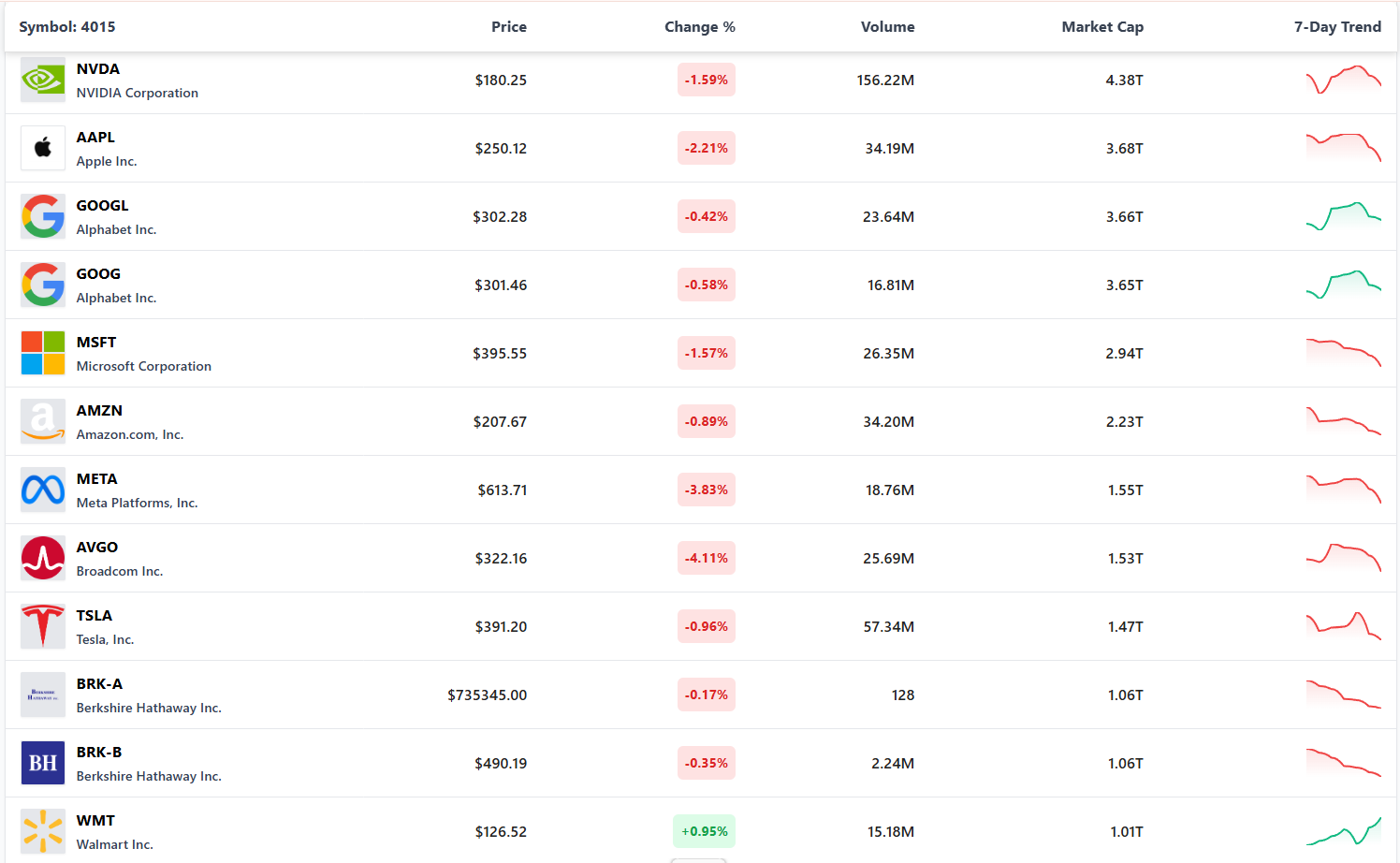
The workflow is direct: pull the top holdings from any global ETF, run them through the intrinsic value calculator or the stock valuation calculator, and check the margin of safety before you allocate. No institutional subscription required. The free tier covers DCF, P/E, and P/S valuations; Tickerplace Pro unlocks full DCF breakdowns, scenario analysis, and advanced screeners for investors who want to go deeper. Start with the stock valuation calculator to run your first valuation check today.
Sources
These sources are reliable starting points for investors who want to go deeper on specific indices, regions, or fund strategies:
- Are you ready to embrace the potential of global equities? | J.P. Morgan Private Bank U.S.
- Case for global equities: Enhancing opportunity, diversification, and risk management | T. Rowe Price
- International stocks | Fidelity Investments
FAQ
What does “global equities” mean?
Global equities are shares in publicly listed companies across both developed and emerging markets worldwide. Unlike “international equities,” which typically exclude the investor’s home market, a global equity fund includes all markets, domestic and foreign.
Is a global equity fund a good investment?
For most individual investors, a global equity fund offers meaningful diversification benefits over a domestic-only portfolio.
What is the difference between international equities and global equities?
“International equities” excludes the investor’s home market; “global equities” includes it. An Australian investor in an international fund holds no ASX stocks, while a global fund holds ASX stocks alongside foreign holdings. Always check the fund’s benchmark to confirm which definition applies.
What is the best global equity fund to invest in?
There is no single answer, since the right fund depends on your cost sensitivity, desired geographic coverage, and whether you want active management or passive index-tracking. For most novice-to-intermediate investors, a low-cost ETF tracking MSCI ACWI or FTSE All-World provides broad, transparent exposure. Use the Tickerplace stock valuation calculator to check whether a fund’s top holdings are fairly valued before investing.
This article provides general information only and is not a substitute for professional financial advice. Confirm current tax treatment, product availability, and suitability with a qualified financial adviser or the relevant product disclosure statement before investing.