
Contango Oil and Gas: Post-Merger Status and Valuation Guide
TL;DR:
- Contango Oil & Gas merged with Independence Energy to form Crescent Energy in late 2021, ending its independent public status.
- Former assets now operate under Crescent or third-party companies, requiring analysts to verify current operators and update valuation models accordingly.
Contango Oil & Gas no longer trades as an independent public company. Its assets were transferred following a December 2021 transaction and are now managed by Crescent Energy and third-party operators including Great Horned Owls, LLC and Aethel. Investors holding legacy Contango exposure should treat those positions as closed and redirect their tracking to acquiring operators and state-level production filings.
Immediate next steps for analysts:
- Pull Crescent Energy’s investor relations page and SEC EDGAR filings (search CIK 1071993 for archived Contango records) for transaction disclosures and pro forma financials.
- Verify the current operator for each well using the API number lookup tools at the relevant state oil and gas commission (Oklahoma, Texas, Wyoming, or Montana).
What happened to Contango Oil and Gas?
Contango Oil & Gas was a Fort Worth, Texas-based independent oil and natural gas company focused on maximizing production and cash flow from onshore properties in the Midcontinent, Permian, and Rockies, as well as shallow-water Gulf of Mexico assets. That independent status ended in late 2021.
Key transaction timeline:
- Pre-2021: — Contango operated as a publicly traded independent, with its primary listings and SEC filings under CIK 1071993.
- Close date: December 7, 2021. The merger was completed, and Crescent Energy began trading on the NYSE under the ticker CRGY.
Pro Tip: To verify transaction status on EDGAR, search for Contango’s CIK (1071993) and filter by filing type. The 8-K filed around December 7, 2021 confirms the close. For any residual obligations, check subsequent 10-K and 10-Q filings from Crescent Energy (CIK search: “Crescent Energy”) and review proxy statements and Form 4s for insider activity around the close date.
Where are the former Contango assets now?
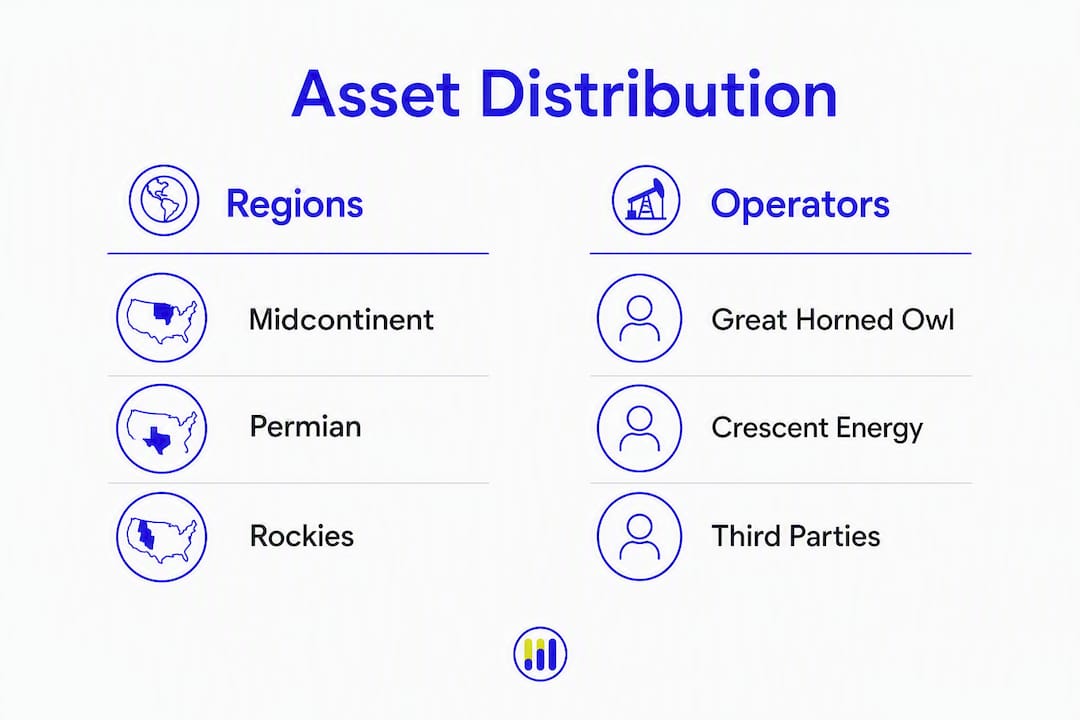
Post-merger, former Contango assets were parceled across multiple operators depending on region. The table below maps each basin to its current operator and the most reliable reporting source.
| Region | Current Operator | Primary Reporting Source |
|---|---|---|
| Midcontinent (Oklahoma) | Great Horned Owls, LLC / third-party | Oklahoma Corporation Commission production data |
| Permian Basin (Texas) | Crescent Energy (direct) | Crescent Energy 10-K/10-Q; Texas RRC |
| Rockies (Wyoming/Montana) | Aethel (post-May 20, 2026 TSA) | Wyoming Oil & Gas Conservation Commission; Montana BOGC |
| Gulf of Mexico (shallow water) | Disposition / third-party | BSEE production data; operator IR |
The Transition Services Agreement that covered Wyoming and Montana properties is a critical detail for analysts. Until the TSA expired on May 20, 2026, reporting obligations were split between Contango’s legacy administrative structure and Aethel’s operational team. After that date, Aethel assumed full reporting responsibility. Always verify the current operator per well using the API number before relying on any single operator’s disclosure.
Last public financials and how to value residual exposure
Contango’s final standalone financials were filed with the SEC prior to the December 2021 close. The table below summarizes the key metrics analysts typically need for revaluation; note that some line items may require reconciliation against Crescent’s pro forma disclosures.

| Metric | Last Reported (Pre-Close) | Source to Verify |
|---|---|---|
| Revenue | Not publicly restated post-close | Archived 10-K on EDGAR (CIK 1071993) |
| Adjusted EBITDA | Not publicly restated post-close | Archived 10-K / Crescent pro forma |
| Net debt | Not publicly restated post-close | Last Contango 10-Q; Crescent merger 8-K |
| Production (boe/d) | Disclosed in final 10-K/10-Q | EDGAR; state commission data |
| Proved reserves (PDP/1P) | Disclosed in final 10-K | EDGAR reserve report exhibits |
Because Crescent Energy absorbed Contango into a combined entity, standalone Contango financials are no longer updated. Analysts revaluing this exposure should pull Crescent’s most recent 10-K and 10-Q from EDGAR, identify the asset-level disclosures that correspond to former Contango properties, and reconcile those against state commission production records.
Recommended valuation models:
- DCF with commodity-price scenarios: Update realized price assumptions, production decline curves, and capex schedules using Crescent’s operator-level disclosures and EIA price forecasts. Discount rates should reflect Crescent’s credit profile, not the legacy Contango standalone.
- P/E comparables: Useful for benchmarking Crescent against mid-cap E&P peers when earnings are positive; less reliable in low-price environments.
- P/S as a sanity check: Apply to Crescent’s revenue base, then attribute a proportional share to former Contango assets using disclosed production splits.
The Tickerplace intrinsic value calculator lets you input updated production, price, and cost assumptions directly into a DCF framework, which is the fastest way to stress-test your model against multiple commodity scenarios.
What does “contango” mean in oil markets?
The word “contango” in the company name refers to a specific oil market structure, not a corporate strategy. In a contango market, futures prices exceed the current spot price, producing an upward-sloping forward curve. The opposite condition, backwardation, occurs when spot prices exceed futures prices.
What contango means in practice, by participant type:
- Producers: A contangoed curve creates incentives to store crude and sell forward at higher prices, but carry costs (storage, financing, insurance) erode that margin quickly.
- Traders: Roll yield turns negative in contango. A long futures position rolled forward each month loses value as the trader sells the expiring contract below the price of the next month’s contract.
- Long-only commodity investors and ETFs: Persistent contango generates negative roll yield, which can significantly drag index and ETF returns even when spot prices are flat or rising.
Analysts should also distinguish between two types of contango. “Normal” contango reflects standard carrying costs (storage, financing, insurance). “Storage-driven” contango reflects local infrastructure bottlenecks that collapse prompt prices relative to forward months; this type can reverse quickly once the bottleneck clears, making it a poor basis for long-term bearish assumptions.
Recent market commentary has noted steepening contango on front months tied to OPEC+ output increases, macro weakness, and US inventory builds, which is relevant context for analysts updating commodity price decks in 2026 valuations.

Pro Tip: Monitor the first two months of the WTI forward strip daily. The front end of the curve reacts fastest to inventory and logistical signals at Cushing. When the intermonth spread widens beyond estimated cost-of-carry (storage + financing + insurance), arbitrage activity typically compresses it back toward full carry — so spreads that appear to justify aggressive storage plays rarely persist.
Practical action items for investors who held Contango
Immediate checks:
- Confirm whether your shares were cashed out, exchanged for Crescent Energy stock, or delisted without consideration; review the merger 8-K and proxy statement for shareholder consideration terms.
- Check for any remaining contingent liabilities or earnout provisions disclosed in the merger agreement.
- Verify that no residual Contango securities remain in your brokerage account under a legacy ticker.
Modeling checklist:
- Replace Contango standalone production curves with Crescent’s disclosed figures for the relevant asset areas.
- Update capex schedules using Crescent’s most recent guidance and operator-level well economics.
- Restate proved reserves using Crescent’s reserve report or the last Contango 10-K reserve exhibit.
- Run at least three commodity price scenarios (base, bear, bull) using current EIA or strip pricing.
- Adjust the discount rate to reflect Crescent’s balance sheet and credit risk, not legacy Contango’s.
- Account for post-close integration costs and any TSA-related administrative expenses.
Red flags to investigate:
- Unresolved environmental liabilities on former Contango wells, particularly in the Rockies.
- Incomplete TSA handoffs where state production data does not yet reflect the new operator.
- Material discrepancies between Crescent’s disclosed production for former Contango assets and state commission records.
- Operator-level reporting gaps for assets assigned to Great Horned Owls, LLC or Aethel that have not yet appeared in state datasets.
For investors reassessing energy exposure more broadly, Tickerplace’s analysis of high-yield energy stocks provides useful context on how the sector is being valued in 2026.
Where to find production data and filings going forward
Primary sources:
- SEC EDGAR (edgar.sec.gov): Search CIK 1071993 for archived Contango filings; search “Crescent Energy” for all post-merger disclosures including 10-K, 10-Q, and 8-K.
- Crescent Energy investor relations (crescentenergyco.com/investors): Quarterly earnings releases, presentations, and reserve reports updated after each reporting period.
- Oklahoma Corporation Commission (oklahoma.gov/occ): Production records for Midcontinent assets; searchable by operator name or API number.
- Texas Railroad Commission (rrc.texas.gov): Permian Basin production data; updated monthly with a typical one-to-two month lag.
- Wyoming Oil & Gas Conservation Commission and Montana Board of Oil and Gas Conservation: Rockies production records for Aethel-operated properties post-TSA.
- EIA weekly inventory reports (eia.gov): Macro crude and product inventory data for updating commodity price assumptions.
Monitoring workflow:
- Use the API number for each well to confirm the current operator in the relevant state commission database before pulling production data.
- Set automated EDGAR alerts for Crescent Energy filings (8-K, 10-Q, 10-K) via the EDGAR email notification system.
- Subscribe to state commission data feeds (Oklahoma and Texas both offer CSV downloads) for production updates.
- Use Tickerplace’s stock valuation tools to run quick P/E and intrinsic value checks on Crescent Energy as the primary successor entity.
Reconciling operator reports with state production data requires patience. State commission records typically lag operator disclosures by one to two months, and the operator name in state records may not update immediately after a TSA handoff. When in doubt, the API number is the authoritative identifier.
Key Takeaways
Contango Oil & Gas is no longer an independent public company; its assets now sit within Crescent Energy or with third-party operators, and all valuation work must be rebuilt from operator-level disclosures and state production data.
| Point | Details |
|---|---|
| Post-merger status | Contango’s ticker was retired after the December 7, 2021 merger forming Crescent Energy. |
| Asset operators | Former assets are now run by Crescent Energy, Great Horned Owls, LLC, and Aethel, depending on region. |
| TSA expiry | The Wyoming/Montana Transition Services Agreement ran through May 20, 2026; Aethel now holds full operational control. |
| Valuation approach | Rebuild models using Crescent’s 10-K/10-Q disclosures, state commission production data, and DCF with updated commodity scenarios. |
| Tickerplace tools | Use Tickerplace’s intrinsic value calculator and stock valuation checker to run DCF and P/E scenarios on Crescent Energy as the successor entity. |
The transaction’s real implication for long-term investors
The Contango-to-Crescent transition is a case study in how E&P consolidation changes the risk profile of an asset without changing the underlying geology. Investors who followed Contango for its Midcontinent or Rockies exposure now face a more complex tracking problem: the assets still produce, but the reporting entity, the balance sheet, and the cost structure have all changed.
The more consequential shift is on the liability side. Crescent absorbed Contango’s assets into a larger, more diversified balance sheet, which reduces single-asset concentration risk but also obscures asset-level performance. Analysts who relied on Contango’s standalone disclosures to model well-level economics now have to work harder to isolate the relevant production and cost data from Crescent’s consolidated filings.
The practical recommendation for portfolio managers: recheck your liquidity assumptions. Crescent Energy trades with different volume and spread characteristics than Contango did, and the operator-level metrics that drove your original thesis may now be buried several layers deep in a combined 10-K. Re-run your DCF using Crescent’s disclosed figures for the relevant asset areas, apply a discount rate that reflects the combined entity’s leverage, and verify production against state commission records before finalizing any position update.
Tickerplace helps you revalue former Contango exposure
Rebuilding a valuation model after a merger is time-consuming when you are pulling data from multiple operator reports, state commissions, and EDGAR filings. Tickerplace gives you institutional-grade DCF, P/E, and P/S valuation tools at no cost, so you can run a quick revaluation of Crescent Energy as the successor entity without a Bloomberg terminal or a spreadsheet built from scratch.
Use the stock valuation calculator to input updated production, price, and cost assumptions and generate an intrinsic value estimate in minutes. The debt-to-equity calculator lets you sanity-check Crescent’s post-merger leverage against E&P peers before committing to a revised position size. If you received Crescent shares in the transaction, the stock average price calculator helps you compute your adjusted cost basis quickly.
Tickerplace is the publisher of this article and provides all valuation tools referenced above. Run your revaluation now at tickerplace.com.
Useful sources
- SEC EDGAR: Search CIK 1071993 for all archived Contango filings; search “Crescent Energy” for post-merger 10-K, 10-Q, and 8-K disclosures. Updated within one business day of filing.
- EIA weekly inventory reports: Macro crude and product inventory data for commodity price deck updates. Released every Wednesday.
- Tickerplace valuation tools: DCF, P/E, P/S calculators and a stock valuation checker for running quick revaluations on Crescent Energy or comparable E&P operators.
FAQ
What happened to Contango Oil and Gas?
Contango Oil & Gas merged with Independence Energy to form Crescent Energy Company, with the transaction closing on December 7, 2021. The legacy Contango ticker was retired at close, and no independent Contango equity remains outstanding.
Who acquired Contango Oil and Gas?
Independence Energy merged with Contango to create Crescent Energy, which now operates many former Contango assets directly; other properties were assigned to third-party operators including Great Horned Owls, LLC and Aethel.
Where was Contango Oil and Gas located?
Contango was headquartered in Fort Worth, Texas, with producing assets in the Midcontinent, Permian Basin, Rockies, and shallow-water Gulf of Mexico.
Where can investors find Contango’s financials now?
Archived Contango filings are available on SEC EDGAR under CIK 1071993; post-merger financials are disclosed in Crescent Energy’s 10-K and 10-Q filings, which can be found on EDGAR or Crescent’s investor relations page.
How does oil market contango relate to the company name?
The company name references the oil-market term “contango,” which describes a futures curve where forward prices exceed the spot price; the name reflects the founders’ familiarity with commodity market structure, not a specific trading strategy.