
Bridge Enterprise Value to Equity With a $2.45 Billion Example

Enterprise value measures what a company’s entire operation is worth to every capital provider, debt and equity alike. Equity value, by contrast, measures only the slice that belongs to shareholders, which for a public company is simply its market capitalization. Acquirers, lenders, and anyone comparing companies with different debt loads lean on enterprise value; shareholders and anyone judging per-share returns lean on equity value.
TL;DR:
- Enterprise value accounts for total company worth to all capital providers, including debt, preferred stock, and minority interests, unlike equity value which focuses only on shareholders.
- When net debt is negative due to excess cash, enterprise value falls below equity value, reflecting the company’s cash surplus used to reduce debt upon acquisition.
- Using the correct multiples with each metric is essential: EV pairs with EBITDA and revenue, while equity value pairs with P/E ratios; mixing these can lead to inaccurate valuations.
- Private companies may require additional adjustments for shareholder loans, operating leases, and contingent liabilities, which can distort the EV to equity bridge if not properly documented.
- Valuation models typically start with enterprise value and perform bridges to equity value by adding or subtracting debt, cash, and other claims, ensuring consistency in financial analysis.
Enterprise Value vs Equity Value: Definitions and Formulas
Enterprise value (EV) represents the total value of a company’s core operations to everyone who has a financial claim on it, not just common shareholders. Equity value represents the piece that belongs to those shareholders after every other claim is satisfied. For a public company, equity value equals market cap: share price multiplied by fully diluted shares outstanding, which means options, warrants, and convertible securities all get folded in before you compare it to anything.
The bridge between the two runs through the balance sheet:
- EV = Equity value + Net debt + Preferred stock + Minority interest
- Net debt = Total interest-bearing debt − Cash and equivalents
- Equity value = EV − Net debt − Preferred stock − Minority interest
Net debt captures how much borrowing a company carries once its own cash cushion is netted out. When cash exceeds debt, net debt turns negative, and enterprise value drops below equity value. That’s not an error; it just means the market is pricing in a company sitting on more cash than it owes. This full formula, laid out clearly by Investopedia, is the one to memorize before touching any comparable-company analysis.
Converting EV to Equity Value (and Back): A Worked Example
Moving between the two numbers is mechanical once you know which direction you’re going.
- Start with equity value. For a public company, that’s share price times fully diluted shares.
- Add net debt. Pull total interest-bearing debt from the balance sheet, subtract cash and equivalents.
- Add preferred stock and minority interest, since both represent claims that sit ahead of common shareholders.
- The result is enterprise value. Reverse the steps, subtracting instead of adding, to go from EV back to equity value.
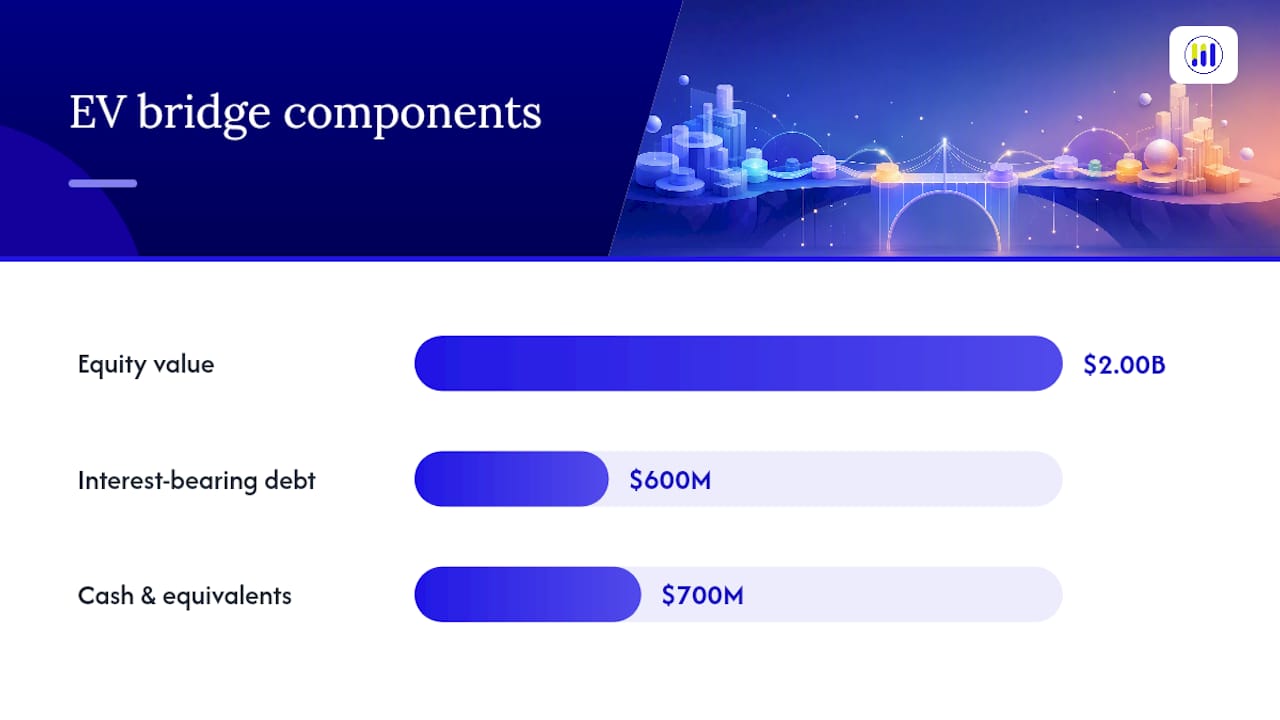
Say a company trades at $40 a share with 50 million diluted shares. Equity value is $2 billion. It carries $600 million in debt and holds $150 million in cash, for net debt of $450 million. No preferred stock, no minority interest. Enterprise value comes out to $2.45 billion.
Now flip the numbers: if that same company held $700 million in cash against $600 million in debt, net debt would be negative $100 million, and EV would fall to $1.9 billion, below equity value. A buyer inherits that cash pile the moment the deal closes and can use it immediately to retire debt, which is exactly why EV reflects the true acquisition cost more honestly than market cap alone.
Pro Tip: Always double check whether “shares outstanding” in a company filing is basic or fully diluted. Using basic shares understates equity value and throws off every ratio built on top of it.
Which Multiples Pair With EV, and Which Belong With Equity Value
Pairing the wrong multiple with the wrong metric is the single most common valuation mistake analysts make, and it produces numbers that look precise while being quietly wrong.
Enterprise value is capital-structure neutral, meaning it doesn’t care whether a company funds itself with debt or equity. That’s why it pairs with pre-interest metrics:
- EV/EBITDA, the most widely used comparable-company multiple
- EV/Revenue, common for early-stage or unprofitable companies
- EV/EBIT, useful when depreciation differences distort EBITDA comparisons
Equity value, on the other hand, reflects what’s left after interest and taxes, so it pairs with post-interest, shareholder-level metrics like the price-to-earnings ratio (P/E). Corporate Finance Institute notes that analysts favor EV for cross-company comparisons precisely because it strips out financing differences that P/E can’t.
Here’s where it goes wrong in practice: dividing EV by net income, which mixes an all-capital-providers numerator with a shareholders-only denominator. Another common slip is comparing P/E across two companies with wildly different debt loads without adjusting for leverage. A cleaner fix in that case is EV/EBITDA, since it neutralizes the capital-structure gap entirely. A DCF built on unlevered free cash flow and WACC produces enterprise value first; only a levered free-cash-flow-to-equity model produces equity value directly, and mixing the two approaches in one model is a reliable way to get a wrong answer.
Common Pitfalls Analysts Run Into With the EV to Equity Bridge
Mixing numerators and denominators is the pitfall that trips up even experienced analysts, and Wall Street Prep’s guidance is blunt about it: the numerator and denominator of any multiple must refer to the same group of capital providers. EV divided by net income fails that test immediately, because EV reflects all claimholders while net income belongs only to common shareholders.
Private companies add complications that the standard formula doesn’t anticipate. Shareholder loans, related-party balances, operating leases, and contingent liabilities can all quietly shift the bridge, and treating enterprise and equity value as interchangeable without adjusting for these items understates or overstates the real value.
- Shareholder loans often function like debt and belong in the net debt calculation, even if they’re not formally structured that way.
- Operating leases, depending on the accounting standard applied, may need to be capitalized and added to debt.
- Contingent liabilities, like pending litigation or earn-outs, rarely show up cleanly on the balance sheet but still affect what a buyer would actually pay.
Financing moves matter here too. Issuing new debt and holding it as cash, or paying a dividend, typically shifts equity value while leaving enterprise value largely unchanged, since those are financing decisions rather than operational ones. For a deeper look at how these adjustments play out when there’s no public market price to anchor the numbers, this guide to illiquid asset valuation is worth reading.
Pro Tip: Document every bridge line item separately rather than lumping shareholder loans, leases, and contingent liabilities into one “adjustments” row. Hiding them makes the bridge impossible to audit later.
How Valuation Calculators Apply the EV-to-Equity Bridge
A Tickerplace enterprise value calculator applies this bridge automatically, and understanding the inputs makes the output far more useful than treating it as a black box.
- Share price and fully diluted shares outstanding, which together produce market cap, the equity value starting point.
- Total interest-bearing debt and cash and equivalents, which combine into net debt.
- Preferred stock and minority interest, added on top to reach enterprise value.
A DCF model produces enterprise value first, using unlevered free cash flow discounted at WACC, before the same net debt subtraction converts it to equity value and, ultimately, a per-share figure. Multiples-based outputs follow the identical path. If you want to test the worked numbers above against a real ticker, Tickerplace’s EV/EBITDA calculator and market cap calculator let you rebuild the bridge step by step and see how sensitive it is to changes in debt or cash.
Why We Look at Both Numbers, Not Just One
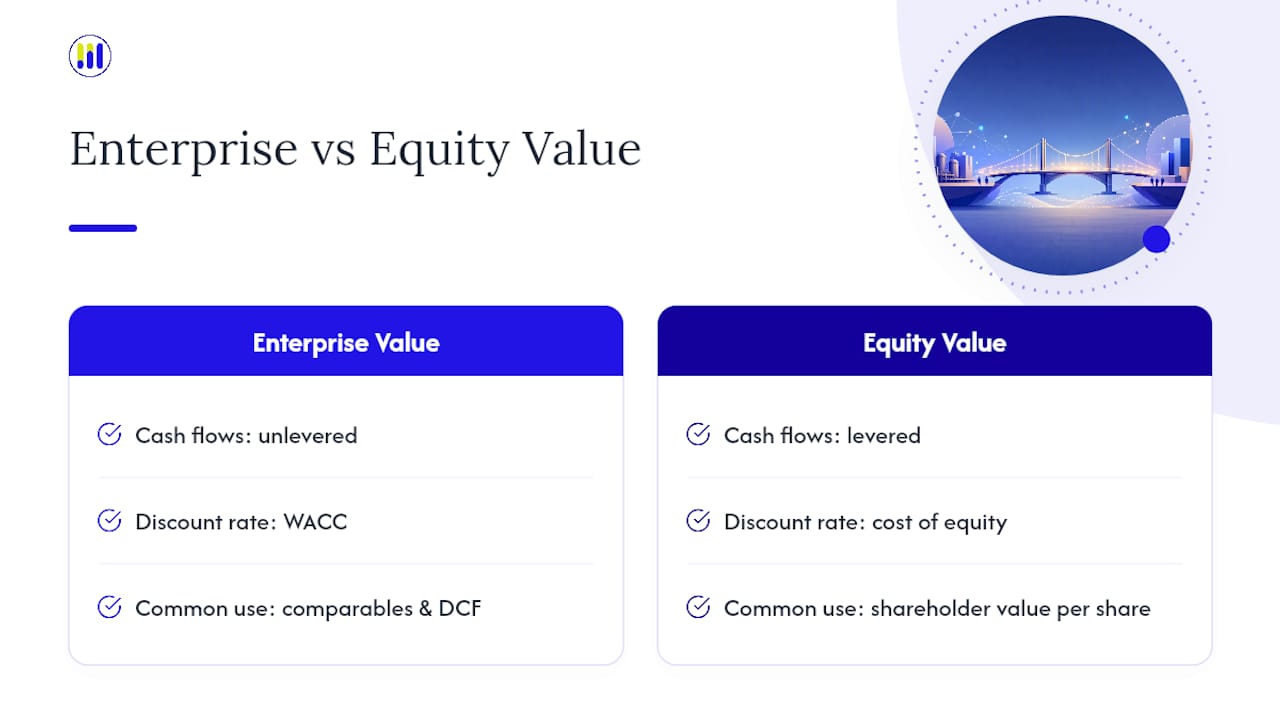
Valuation work that starts with equity value alone tends to miss how debt loads distort peer comparisons. One common approach starts with enterprise value for comparables and DCF work, then bridges down to equity value once the question shifts to what a shareholder actually owns per share.
The discipline that matters most: keep cash flows and discount rates matched to whichever metric you’re building toward. Unlevered flows and WACC belong to enterprise value; levered flows and cost of equity belong to equity value. Crossing the two is where good models quietly go wrong.
— Tickerplace
Sources
For readers who want the underlying mechanics in more depth, Investopedia’s breakdown of enterprise value versus equity value and Corporate Finance Institute’s explainer both cover the formula in more technical detail. Tickerplace’s enterprise value guide walks through the same bridge alongside a working calculator, and the Stock Valuation Calculator applies it directly to individual tickers using DCF, P/E, and P/S models. Try running a real stock through Tickerplace’s Stock Valuation Checker to see the bridge from enterprise value to a fair per-share estimate in practice.
This article is general information, not a substitute for advice from a qualified financial advisor. Consult a qualified financial professional about your own circumstances before acting on anything here.
- Enterprise Value versus Equity Value
- Enterprise Value vs. Equity Value in Business Valuation
- Enterprise Value vs Equity Value
FAQ
What Is a Good Enterprise Value to EBITDA Ratio?
There’s no universal “good” number since EV/EBITDA varies heavily by industry and growth rate; the multiple only becomes meaningful when compared against similar companies in the same sector rather than judged in isolation.
How Do You Convert Enterprise Value to Equity Value?
Subtract net debt, preferred stock, and minority interest from enterprise value; what remains is equity value, which for public companies should match market capitalization.
How Do You Bridge From Equity Value to Enterprise Value?
Start with equity value (market cap), then add net debt, preferred stock, and minority interest to arrive at enterprise value, following the standard formula used across valuation and M&A work.
Why Is Cash Subtracted When Calculating Enterprise Value?
Cash is subtracted because a buyer acquiring the company gains that cash immediately and can use it to pay down debt, so it effectively lowers the true cost of the acquisition relative to the market cap alone.