
Fortescue Share Price in 2026: What Investors Must Know

TL;DR:
- Fortescue’s share price experienced a sharp increase followed by a recent 6% decline without material news, reflecting market volatility. Analysts largely see limited upside with a consensus target around A$18.90, indicating about 13% downside from current levels. The company’s valuation is influenced by iron ore prices, Chinese demand, geopolitical factors, and long-term decarbonization investments, requiring careful monitoring before making trading decisions.
Fortescue’s share price has become one of the more compelling stories on the ASX this year. After spiking about 15% in early May 2026 and touching a multi-year high near A$22.99, the stock pulled back roughly 6% across just three consecutive trading sessions, all without any material company announcement. That kind of volatility demands explanation. This guide covers the key drivers behind recent Fortescue Metals share performance, what analysts are forecasting, how the financials stack up, and what you should be watching before making any trading decision.
Key takeaways
| Point | Details |
|---|---|
| Recent price spike and pullback | Fortescue reached a multi-year high near A$22.99 before retreating 6% with no material news catalyst. |
| Analyst consensus skews bearish | The consensus price target of A$18.90 implies roughly 13% downside from current trading levels. |
| Iron ore remains the core driver | Commodity price fluctuations and grade discounts directly shape Fortescue stock value and near-term revenue. |
| Dividend yield adds income appeal | A first-half dividend of 62 cents per share at a 65% payout ratio provides measurable income support. |
| Balance sheet is manageable but stretched | A debt/equity ratio of 27.6% is conservative, yet a $6.2 billion decarbonization program pressures near-term cash flow. |
Share price Fortescue: key drivers in 2026
No single variable explains Fortescue’s price moves in isolation. The stock sits at the intersection of global commodity demand, company-specific financial decisions, and broader investor sentiment toward Australian resource equities.
Iron ore is the most direct input. When prices climbed above US$111 per tonne recently, Fortescue’s market sentiment improved quickly. The catch is that Fortescue’s Pilbara blend ore consistently trades at a discount to the 62% benchmark iron content price because of its lower grade, meaning realized revenues per tonne fall short of the headline commodity price. That discount can shave meaningful dollars off revenue during periods of tight spreads.
Several factors are worth monitoring closely:
- Iron ore spot price: The single largest influence on revenue and, by extension, Fortescue stock value. A sustained price below US$90 per tonne historically compresses margins significantly.
- Chinese steel demand: Fortescue ships the vast majority of its ore to China. Any slowdown in Chinese property or infrastructure spending directly dampens demand and, with it, pricing power.
- Geopolitical and shipping costs: Tariff tensions and freight rate volatility affect the cost side of Fortescue’s operations and reduce free cash flow available for dividends and investment.
- Green energy diversification: Fortescue’s push into green hydrogen and renewable energy is a long-term strategic play. In the near term, it adds capital expenditure pressure rather than revenue contribution.
For context, consider how peers like Rio Tinto and BHP carry more diversified commodity exposure across copper, coal, and aluminium. Fortescue remains far more exposed to a single commodity, which amplifies both upside and downside price swings.
Pro Tip: When monitoring the current price Fortescue trades at, always check the concurrent iron ore spot price. A divergence between the two, where Fortescue rises while iron ore slips, often signals speculative positioning rather than fundamental strength.
Analyst consensus and price targets
Understanding where analysts collectively stand on Fortescue is one of the most practical inputs for calibrating your own position sizing and risk management.
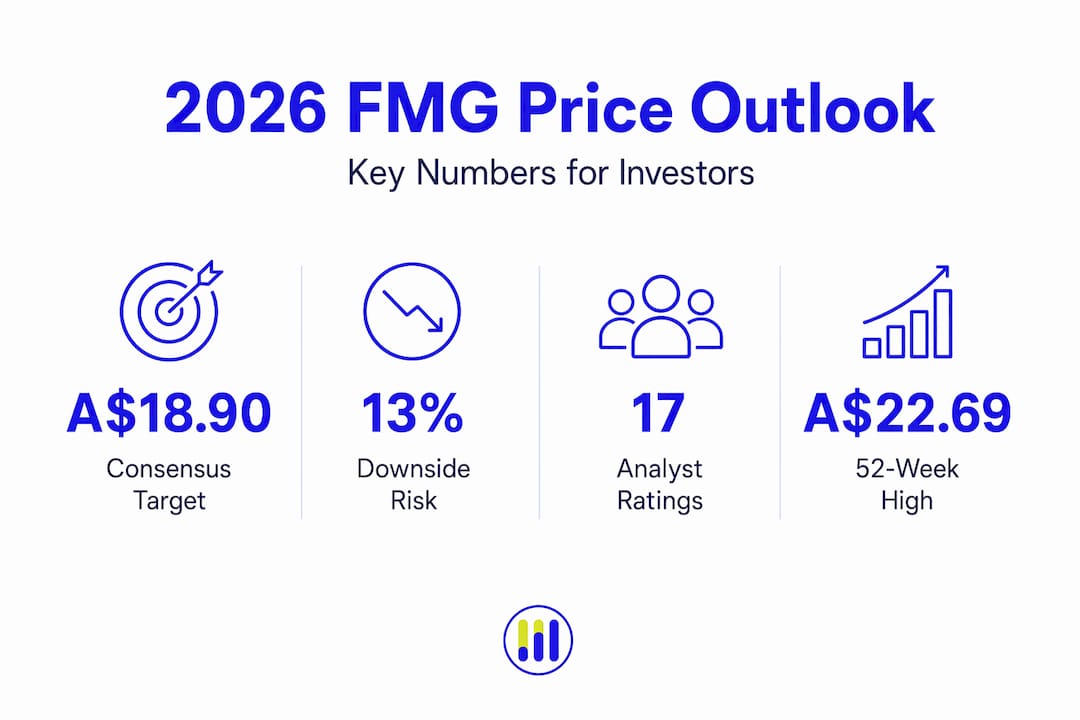
The picture is notably cautious. Based on 17 tracked analysts, ratings are evenly split between Sell/Strong Sell and Hold, with just one Strong Buy on record. That distribution reflects a market where most institutional analysts see the current price as stretched relative to fundamentals.
| Rating | Number of Analysts | Price Target Range |
|---|---|---|
| Strong Buy | 1 | Above A$22.00 |
| Hold | ~8 | A$19.00 to A$22.00 |
| Sell / Strong Sell | ~8 | A$15.00 to A$18.50 |
| Consensus target | All 17 | ~A$18.90 |
Bell Potter, one of the more prominent voices on the sell side, has issued a Sell rating with a price target of A$18.15, citing second-half cost escalation risks and uncertainties tied to Fortescue’s ongoing portfolio restructuring. That target represents a scenario where margins compress and the green energy transition continues to weigh on near-term earnings.
The consensus Fortescue share price forecast of approximately A$18.90 implies around 13% downside from trading levels near A$21.66. That does not mean the stock will fall to that level, but it does suggest that most professional analysts believe upside is limited at current valuations.
Pro Tip: Consensus targets are averages, not guarantees. Examine the distribution of estimates rather than just the midpoint. A wide spread between the most bullish and most bearish analyst often signals high uncertainty about a company’s earnings trajectory.
Financial metrics shaping Fortescue’s valuation
The financial backdrop for Fortescue in 2026 is a study in contrasts. The balance sheet is structurally sound, but earnings momentum has been moving in the wrong direction for several years.
- Revenue and profit trend: Fortescue’s 3-year revenue CAGR sits around -6.5%, with profit contracting at approximately -18% per year over the same period. The most recently reported profit of $5,683 million compares to $10,295 million three years prior. That contraction matters for valuation, particularly if iron ore prices moderate from current levels.
- Dividend income: Fortescue declared a first-half dividend of 62 cents per share, up from 50 cents in the prior period, at a 65% payout ratio. Shares rose 2.6% on the announcement, indicating that income investors remain a meaningful component of the shareholder base. The current dividend yield sits near 3.85%, which provides some cushion against capital loss.
- Balance sheet: The debt/equity ratio of 27.6% is relatively conservative for a capital-intensive miner. However, the $6.2 billion decarbonization investment program will continue to absorb free cash flow through the medium term, limiting the company’s capacity to return additional capital.
- Valuation multiples: With the stock trading near A$21.27 and a price-to-earnings ratio of 12.59, Fortescue is not extravagantly priced in absolute terms. For comparison, that multiple is broadly in line with global mining sector averages, though the declining earnings trajectory makes it harder to justify a premium.
You can review ASX financials to benchmark these metrics against peer companies on the exchange in real time.
Interpreting recent price movements
The 6% pullback from Fortescue’s multi-year high has left many investors wondering whether it represents a buying opportunity or a warning signal. A disciplined approach to answering that question involves a few structured steps.
- Identify the catalyst gap. The spike to near A$22.99 occurred without any corresponding company announcement. That suggests market-wide momentum and speculative positioning, rather than a fundamental re-rating. Pullbacks from sentiment-driven spikes tend to be sharper and less predictable than corrections following earnings misses.
- Monitor trading volume. Volume patterns during the sell-off matter. Heavy volume on down days without offsetting institutional buying days often signals that larger holders are reducing exposure, not simply that retail traders are taking profits.
- Track iron ore’s trajectory. Given how tightly Fortescue’s share price correlates with iron ore, watching for the commodity to stabilize above key technical levels provides a more reliable signal than analyzing the equity chart in isolation.
- Set price level alerts around the consensus target. With the analyst consensus at approximately A$18.90, a move toward that range would reduce the gap between price and fair value estimates considerably, making a more compelling entry case.
- Watch company announcements closely. Production reports, quarterly operational updates, and any changes to the decarbonization capital program can shift the earnings outlook quickly. A downgrade to iron ore shipment guidance, for example, would likely accelerate the pullback already underway.
The 52-week range of A$13.46 to A$22.69 tells a clear story: Fortescue is currently trading near the strong end of that range, which historically has been associated with more limited forward returns and greater mean-reversion risk.
My take on Fortescue’s risk-reward in 2026

I’ve watched commodity-linked stocks cycle through these patterns enough times to recognize what this moment looks like. When a stock spikes 15% in weeks without a single material announcement, you are almost certainly looking at a momentum trade, not a fundamental re-rating. That does not make the stock wrong to own. It makes the entry price far more consequential.
My honest read on Fortescue is this: the long-term thesis is credible. The decarbonization bet is audacious, but it is the kind of strategic differentiation that could matter a great deal a decade from now. The near-term picture is harder to defend at current prices. A 13% implied downside from analyst consensus is not trivial, particularly against a backdrop of contracting earnings and an iron ore price that is not guaranteed to hold above US$100.
I would not dismiss Fortescue as a holding. The Fortescue share price forecast environment for Australian resource stocks broadly remains tied to China’s macro trajectory. What I would resist is chasing this stock at or near a multi-year high when the analyst community is nearly unanimously telling you the price has run ahead of value. Patience here is a discipline, not a missed opportunity.
The dividend yield near 3.85% provides partial justification for holding through volatility. But for new positions, waiting for the price to close the gap to consensus before entering gives you a materially better risk-reward profile.
— Tickerplace
Use Tickerplace to track Fortescue shares
If you are actively monitoring how to invest in Fortescue or comparing it against broader ASX resource stocks, having the right tools available makes the difference between reactive trading and informed decision-making.
Tickerplace provides real-time price data, technical and fundamental analysis tools, and financial statement breakdowns for global equities including ASX-listed companies. You can use the stock screener to filter mining stocks by P/E ratio, dividend yield, and debt levels, giving you a structured way to compare Fortescue’s metrics against sector peers. The platform’s financial calculators help you model dividend income scenarios and estimate forward returns based on different iron ore price assumptions. Whether you are building a research case or monitoring an existing position, Tickerplace puts the data you need in one place.
FAQ
What is the current share price of Fortescue?
Fortescue shares were trading near A$21.66 as of May 2026, after pulling back roughly 6% from a multi-year high near A$22.99. Prices fluctuate daily with iron ore and broader market sentiment.
What is the analyst price target for Fortescue in 2026?
The consensus price target across 17 tracked analysts is approximately A$18.90, implying around 13% downside from current levels. Ratings skew toward Hold and Sell, with just one Strong Buy on record.
Why did the Fortescue share price drop recently?
Fortescue shares fell about 6% over three consecutive sessions after reaching a multi-year high, with no material company news. The move is consistent with profit-taking after a momentum-driven 15% spike earlier in May 2026.
What is Fortescue’s dividend yield?
Fortescue’s current dividend yield sits near 3.85%, supported by a first-half dividend of 62 cents per share at a 65% payout ratio. The increased payout reflects confidence in near-term cash generation despite longer-term investment pressures.
Is Fortescue a good investment in 2026?
Fortescue carries meaningful risk at current prices given contracting earnings and a bearish analyst consensus. The dividend yield and long-term decarbonization strategy provide support, but a revenue CAGR of -6.5% over three years warrants caution before initiating a new position near multi-year highs.