
Algorithmic Trading Explained for Individual Investors
TL;DR:
- Algorithmic trading involves automated execution of trades based on pre-set rules, controlling speed and emotion. It offers benefits like precise order timing and systematic validation but carries risks such as model failure and market feedback loops. Retail investors should focus on simple, well-understood strategies and rigorous testing within current regulatory frameworks.
Algorithmic trading is the automated execution of financial orders using pre-programmed software instructions based on variables like price, timing, and volume. In plain terms, a computer follows a defined set of rules to decide when to buy or sell, then places the order faster than any human could. According to a 2019 study cited by Wikipedia, as of 2019, an estimated 92% of Forex market trading was performed by algorithms, a statistic that illustrates just how thoroughly automated execution has reshaped modern markets.
For individual investors, the honest TL;DR looks like this:
- When it helps: Consistent, rules-based execution; removing emotional bias from entries and exits; slicing large orders to reduce market impact; running systematic strategies across multiple instruments simultaneously.
- When it doesn’t: The learning curve is steep, infrastructure costs add up, and a poorly tested algorithm can lose money faster than a human ever would. Monitoring requirements are ongoing, not optional.
- Who oversees it in the U.S.: The SEC, FINRA, and CFTC each play a role depending on the asset class and firm type.
Whether you are a self-directed trader curious about automation or a long-term investor wondering whether algorithms belong in your process, this guide covers every layer: how the systems work, which strategies are realistic for retail traders, what the risks actually look like, and how to start without blowing up your account.
How does algorithmic trading work?
At its core, an algorithmic trading system does one thing: it monitors market data continuously, evaluates that data against a set of pre-defined rules or a statistical model, and submits orders to an exchange or broker when the conditions are met. The SEC’s equity market structure literature describes how these systems address multiple simultaneous decisions: which instrument to trade, what order size to use, which venue to route to, and how risk changes as trade size grows. Each of those decisions happens in milliseconds.
The key components every algo system needs
Signal generation. The algorithm starts with a signal: a quantitative trigger derived from price data, volume, technical indicators, fundamental ratios, or alternative data feeds. Without a reliable signal, nothing downstream matters.
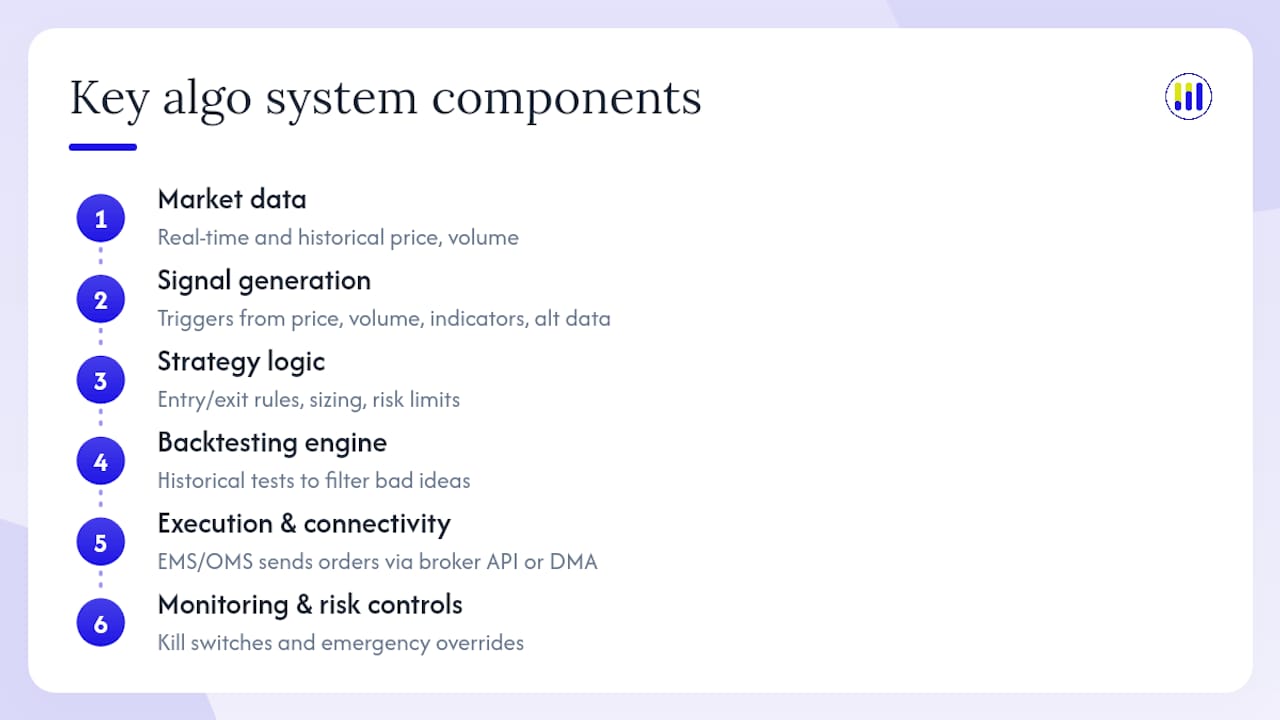
Strategy logic. The signal feeds into a model or rule set that defines the exact conditions for entry, exit, position sizing, and risk limits. This is where the strategy lives.
Backtesting engine. Before any real capital is at risk, the strategy is tested against historical data to estimate how it would have performed. Backtesting is not proof of future results, but it is the primary filter for discarding bad ideas early.
Execution management system (EMS) or order management system (OMS). Once the strategy fires, an EMS or OMS translates the decision into actual orders. It handles order types, timing, and routing logic.
Broker API and market connectivity. The system connects to a broker or exchange via an application programming interface (API). For retail traders, this is typically a REST or WebSocket API provided by the broker. For institutional desks, direct market access (DMA) and co-location reduce latency further.
Market data feeds. Real-time and historical price, volume, and order-book data are the raw material. Data quality matters enormously: a feed with gaps or errors will corrupt both backtests and live signals.
Monitoring and risk controls. A live algorithm without active monitoring is a liability. Professional desks implement kill switches and emergency overrides to halt an algo instantly during extreme market events. This control is often the last thing beginners think about and the first thing they regret skipping.
Common order types algorithms use
Algorithms rely on a range of order types beyond a simple market order. Limit orders set a price ceiling or floor. Stop orders trigger at a threshold. Immediate-or-cancel (IOC) and fill-or-kill (FOK) orders manage partial fills. Hidden or iceberg orders conceal true size from the order book. Smart-order routing (SOR) technology splits a single order across multiple venues to find the best available price and liquidity, a capability described in detail by Quod Financial’s execution primer.
Pro Tip: Before your algorithm goes live, build a kill switch into the code itself: a hard position limit and a daily loss threshold that automatically cancels all open orders and halts new ones. This single control has saved professional traders from catastrophic losses during data feed errors and flash events.
What are the most common algorithmic trading strategies?
QuantInsti’s educational primer groups algorithmic strategies into a handful of well-defined families. Understanding which category a strategy belongs to tells you a great deal about its data requirements, risk profile, and whether it is realistic for a retail trader to implement.
Trend-following and systematic momentum
These strategies buy assets that have been rising and sell (or short) assets that have been falling, based on the premise that price trends persist over time. A simple example in pseudocode:
IF 20-day moving average > 50-day moving average:
    BUY signal
IF 20-day moving average < 50-day moving average:
    SELL signal
Trend-following is one of the oldest and most studied systematic approaches. It works across equities, futures, and currencies, and it is accessible to retail traders with basic programming skills. The Tickerplace guide to trading strategies covers how these approaches fit different investor profiles.
Mean reversion
Mean reversion strategies assume that prices tend to return to a historical average after deviating from it. A pairs-trading example: if Stock A and Stock B historically move together but Stock A drops sharply relative to Stock B, the algorithm buys A and shorts B, expecting the spread to close. These strategies require careful statistical validation and tend to break down during structural market shifts.
Statistical arbitrage
A more sophisticated form of mean reversion, statistical arbitrage (stat arb) exploits pricing inefficiencies across related instruments using quantitative models. It typically requires faster execution and more complex infrastructure than simple mean reversion, placing it closer to the institutional end of the spectrum.
Market-making
Market-making algorithms continuously post both a bid and an ask, profiting from the spread. They require deep liquidity, very low latency, and significant capital. This is firmly institutional territory for most retail traders.
High-frequency trading (HFT)
HFT is a subset of algorithmic trading characterized by extremely high order volumes, very short holding periods (often milliseconds), and co-located servers. The infrastructure costs alone put it out of reach for individual investors. It is worth understanding conceptually, but it is not a realistic starting point for retail traders.
Machine learning and deep reinforcement learning (DRL)
Modern systems increasingly integrate machine learning models that adapt to changing market conditions rather than following fixed rules. Deep reinforcement learning, in particular, allows an algorithm to learn optimal trading policies through simulated experience. These approaches are powerful but require substantial data science expertise and are harder to interpret and audit than rule-based systems.
Realistic for retail traders: Execution algorithms (VWAP/TWAP via broker), trend-following, and basic mean reversion. Statistical arbitrage is achievable with effort. Market-making and HFT are not practical for individual investors.
What are the real benefits and risks of algorithmic trading?
The genuine advantages
Investopedia’s in-depth guide identifies execution speed, reduced emotional bias, and the ability to backtest as the three most cited advantages. Each one is real, but each comes with a caveat.
Speed. Algorithms execute in milliseconds. For strategies that depend on price precision or rapid reaction to data releases, human execution simply cannot compete. For a long-term investor buying a position over several days, speed matters far less.
Emotion-free execution. An algorithm does not panic during a market selloff or chase a momentum trade out of excitement. It follows its rules. This consistency is genuinely valuable, particularly for investors who have struggled with discipline in the past.
Backtesting and systematic validation. You can test a strategy against years of historical data before risking a dollar. No other investment approach offers this kind of pre-deployment validation framework.
Order slicing and reduced market impact. By breaking large orders into smaller child orders executed over time, algorithms reduce the price impact of the trade itself. This is especially relevant for investors managing meaningful position sizes.
24/7 coverage. For assets that trade around the clock, such as cryptocurrency or certain futures markets, an algorithm can monitor and act while you sleep.
The operational risks you cannot ignore
Model risk. A strategy that worked in a historical backtest may fail in live markets because the conditions that generated the historical signal no longer exist. Markets change regimes: a mean-reversion strategy that thrived in a low-volatility environment can lose steadily in a trending one.
Flash crashes and systemic amplification. When many algorithms react to the same signal simultaneously, they can amplify price moves dramatically. The May 2010 Flash Crash, during which the Dow Jones Industrial Average dropped nearly 1,000 points in minutes before recovering, is the most cited example of algorithmic feedback loops creating extreme short-term volatility.
Data feed errors. A corrupted or delayed data feed can cause an algorithm to fire on a false signal. Without proper data validation in the code, a single bad tick can trigger a cascade of erroneous orders.
Infrastructure failures. Server outages, API rate limits, and network interruptions can leave an algorithm unable to execute, unable to exit a position, or stuck in a loop. Redundancy planning is not optional for live systems.
Ethical and market manipulation concerns. Certain algorithmic practices, such as layering (placing and canceling large orders to create a false impression of demand) and spoofing, are illegal under U.S. securities law. Even unintentional patterns that resemble manipulation can attract regulatory scrutiny. Understanding the boundary between aggressive execution and prohibited conduct is a legal obligation, not just a best practice.
What are the U.S. regulatory rules for algorithmic trading?
Three federal regulators share oversight of algorithmic trading in the United States, and which one matters most to you depends on what you trade.
The SEC oversees equity and options markets. Its staff reports on equity market structure, including the High Frequency Trading literature review, document both the liquidity benefits and the systemic risks that algorithms introduce. The SEC’s Regulation NMS establishes best execution obligations and the framework for order routing across fragmented equity venues.
FINRA regulates broker-dealers and their associated persons. If you use a FINRA-member broker to run an algorithm, that broker is responsible for supervising algorithmic activity on its platform. FINRA has published guidance on algorithmic trading controls, including requirements for testing, pre-trade risk checks, and surveillance.
The CFTC oversees futures, swaps, and certain derivatives markets. If your algorithm trades futures contracts (equity index futures, commodity futures, or interest rate futures), CFTC rules apply, including Regulation AT, which addresses automated trading controls for registered firms.
Practical checklist for retail traders:
- Know your broker’s algorithmic trading policy before you start. Some brokers restrict or prohibit certain automated strategies.
- Test every strategy in paper trading (simulated) mode before committing real capital.
- Document your strategy logic, parameters, and any changes you make over time. Regulators expect firms to maintain records; individual traders benefit from the same discipline.
- Never implement patterns that could be construed as layering, spoofing, or wash trading, even accidentally.
- Understand that “I didn’t know it was illegal” is not a defense under securities law.
This article provides general information about U.S. regulatory frameworks, not legal advice. Confirm current rules with the SEC, FINRA, CFTC, or a qualified securities attorney before deploying any live algorithmic strategy.
How do you start with algorithmic trading as a retail investor?
The single most important piece of advice for beginners: start with a strategy you understand completely before you automate it. Automating a strategy you cannot explain is not sophistication; it is a faster way to lose money.
-
Define your goals and constraints. What problem are you solving? Better execution of long-term buys? A systematic momentum overlay? Decide before you write a line of code. Set a maximum capital allocation you are prepared to lose entirely during the learning phase.
-
Choose your asset class and timeframe. Equities with daily bars are the most forgiving starting point: data is widely available, transaction costs are transparent, and the pace allows time to monitor and adjust. Intraday strategies require faster infrastructure and tighter cost management.
-
Learn basic programming or choose a no-code tool. Python is the dominant language for retail algorithmic trading, with libraries including Pandas, NumPy, and Backtrader handling most of the heavy lifting. If coding is a barrier, no-code platforms like QuantGenie allow you to build and test rule-based strategies without writing code from scratch.
-
Select a broker with a reliable API. Look for a broker that offers a well-documented API, paper trading capability, and clear policies on automated order submission. Retail-accessible platforms like MetaTrader and TradingView also support automated strategies through their built-in scripting environments, as noted by OANDA’s algorithmic trading overview.
-
Acquire clean historical data. Free data sources exist but often contain gaps, errors, and survivorship bias. For serious backtesting, a paid data provider with point-in-time accuracy is worth the cost.
-
Build and backtest your strategy. Code the rules, run the backtest, and analyze results under realistic assumptions: include commissions, slippage, and bid-ask spread. A strategy that looks profitable before costs often breaks even or loses after them.
-
Forward-test on paper. Run the algorithm in real time using simulated capital for at least several weeks. This catches bugs, data feed issues, and behavioral problems that backtests miss.
-
Deploy with strict risk limits. Start with the smallest position size your broker allows. Set a daily loss limit and a maximum drawdown threshold that automatically halts the algorithm. Review performance weekly, not just when something goes wrong.
Pro Tip: Before your first live trade, add three hard limits to your code: a maximum position size per instrument, a maximum daily loss in dollar terms, and a maximum number of orders per minute. These three controls catch the most common beginner disasters: oversizing, runaway losses, and API loops.
What does it actually cost to run a retail trading algorithm?
The gap between “I can run an algo for free” and “I can run an algo that works reliably” is measured in both dollars and time. Here is a realistic breakdown.
| Cost Item | Minimal Setup | Mid-Range Setup |
|---|---|---|
| Historical market data | Free (broker-provided or Yahoo Finance) | $50/month (paid data provider) |
| Real-time data feed | Included with broker API | $50/month (direct exchange feed) |
| Cloud compute / VPS | $5–$20/month (basic VPS) | $50/month (low-latency hosting) |
| Backtesting software | Free (open-source Python libraries) | — |
| Broker commissions | $0 (commission-free equity brokers) | Variable (futures, options, FX) |
| Monitoring and alerting | Free (custom scripts) | $20–$50/month (commercial alerting tools) |
Beyond the monthly line items, there are hidden costs worth naming:
- Time. Building, testing, and maintaining an algorithm takes far more hours than most beginners expect. A simple trend-following system might take 40–80 hours to build and validate properly.
- Model maintenance. Markets change. A strategy that performs well for 12 months may need recalibration or replacement. Ongoing maintenance is a recurring time cost.
- Learning curve. Programming errors, data mistakes, and conceptual misunderstandings each cost time and sometimes money to diagnose.
Realistic timeline from idea to live deployment:
- Simple rule-based strategy (daily bars, single instrument): 4–8 weeks from concept to paper trading.
- Moderately complex multi-instrument system: 3–6 months.
- Production-grade system with robust risk management and monitoring: 6–12 months or longer.
These ranges assume part-time effort. Full-time focus compresses them, but does not eliminate the validation steps.
How do you backtest properly and avoid overfitting?
The correct goal of backtesting is not to find a strategy that looks good on historical data. It is to estimate realistic out-of-sample performance under realistic cost assumptions. That distinction changes everything about how you run and interpret a backtest.
-
Split your data into three sets. Use a training set to develop the strategy, a validation set to tune parameters, and a held-out test set that you touch only once, at the very end. If you keep adjusting the strategy after seeing test-set results, the test set becomes part of the training process and loses its predictive value.
-
Use walk-forward analysis. Rather than a single train/test split, walk-forward analysis rolls the training window forward in time, testing the strategy on successive out-of-sample periods. This simulates how the strategy would have performed if deployed incrementally and is far more realistic than a single backtest run.
-
Model realistic costs. Include commissions, bid-ask spread, and slippage (the difference between the price your algorithm targets and the price it actually gets). A strategy that earns 0.1% per trade before costs may lose money after a $0.01 spread and a $1 commission.
-
Check for look-ahead bias. This is the most common and most damaging backtest error. It occurs when the strategy uses information that would not have been available at the time of the trade, such as using the closing price of a bar to generate a signal that executes at that same bar’s close. Every data point in your signal must be available before the order is placed.
-
Account for survivorship bias. If your backtest universe includes only companies that exist today, it excludes every company that went bankrupt or was delisted during the test period. This makes historical results look better than they were.
-
Limit the number of parameters. Every additional parameter you optimize is an opportunity to overfit. A strategy with 10 optimized parameters that works on historical data is almost certainly curve-fitted to noise. Prefer simple rules with few free variables.
Pro Tip: Run your final strategy on the held-out test set exactly once. If the results disappoint, resist the urge to go back and adjust. That adjustment is overfitting by another name. If the strategy does not survive a clean out-of-sample test, it is not ready for live capital.
Does algorithmic trading fit a long-term, valuation-first investing approach?
The short answer: algorithmic trading and valuation-driven investing are not mutually exclusive, but they serve different purposes and require different skills. Knowing which one fits your situation is more valuable than trying to master both simultaneously.
When algorithms complement long-term investing:
- Execution algorithms (VWAP, TWAP) help long-term investors build or exit large positions without moving the price against themselves. This is a practical, low-complexity application that requires no strategy development.
- Systematic rebalancing rules can automate the discipline of trimming overweight positions and adding to underweight ones on a schedule, removing the emotional friction of those decisions.
- Screening algorithms can filter a universe of thousands of stocks down to a shortlist that meets specific valuation or quality criteria, feeding a fundamental research process rather than replacing it.
When they conflict:
- A long-term investor’s edge comes from patience, valuation discipline, and holding through volatility. Short-term algorithmic strategies often require the opposite: frequent trading, tight stop-losses, and rapid adaptation to price signals that have no bearing on a company’s intrinsic value.
- The time and capital required to build and maintain a live algorithmic system can distract from the core work of fundamental research and portfolio construction.
| Dimension | Algorithmic Trading | Valuation-Driven Investing |
|---|---|---|
| Time horizon | Milliseconds to months | Months to years |
| Primary edge | Speed, consistency, scale | Research, patience, discipline |
| Key skill | Programming, statistics | Financial analysis, judgment |
| Infrastructure cost | Moderate to high | Low (tools and data) |
| Emotional challenge | Trusting the system | Holding through drawdowns |
Pro Tip: If you are a long-term investor who occasionally buys large blocks of a single stock, ask your broker whether they offer VWAP execution for equity orders. Many retail brokers provide this as a standard order type. It is the simplest form of algorithmic execution and requires no programming.
For investors who want to screen stocks by valuation metrics, compare intrinsic value estimates, and make disciplined buy decisions, tools like Tickerplace’s stock screener and valuation calculators deliver the analytical depth of institutional research without requiring any code.
Key Takeaways
Algorithmic trading automates order execution through pre-programmed rules, offering speed and consistency, but it requires rigorous backtesting, ongoing monitoring, and a clear understanding of U.S. regulatory obligations before any live capital is deployed.
| Point | Details |
|---|---|
| Core definition | Algorithmic trading executes orders automatically via pre-programmed rules based on price, volume, and timing. |
| Realistic strategies for retail | Execution algorithms (VWAP/TWAP), trend-following, and basic mean reversion are achievable; HFT and market-making are not. |
| Primary risks | Model failure, system outages, overfitting, and flash-crash amplification are the most consequential dangers. |
| Regulatory oversight | The SEC, FINRA, and CFTC each oversee different asset classes; retail traders must understand their broker’s algorithmic policies. |
| Tickerplace alternative | Long-term investors who prefer valuation-first decisions can use Tickerplace’s intrinsic value tools instead of building algorithms. |
The realistic role of algorithmic trading for individual investors
Most coverage of algorithmic trading focuses on what is technically possible. Tickerplace’s perspective is grounded in what is practically useful for the individual investor who has a day job, a long-term portfolio, and limited time to maintain a live system.
The honest assessment: algorithmic trading is a powerful tool in the right hands, but it is not a shortcut to better returns. The strategies that work are not secret; they are well-documented, widely tested, and competed away over time by better-resourced participants. What remains for the retail trader is a narrower set of genuine applications: disciplined execution, systematic rebalancing, and rules-based screening. These are worth pursuing.
What is not worth pursuing, for most individual investors, is the belief that a simple algorithm will consistently outperform a patient, valuation-disciplined approach to buying quality companies at fair prices. The evidence for long-term, fundamentals-driven investing is deep and well-established. The evidence that retail algorithmic strategies generate sustainable alpha after costs is far thinner.
The most responsible path is incremental: start with execution automation, validate everything before risking real capital, and never automate a strategy you cannot explain and monitor. Complexity is not sophistication. A simple, well-understood system that you can diagnose when it breaks is worth more than an elaborate one that you cannot.
Tickerplace gives long-term investors institutional-grade valuation tools
Individual investors who want analytical depth without building a trading algorithm have a direct alternative in Tickerplace. Where algorithmic trading demands programming skills, infrastructure, and constant monitoring, Tickerplace delivers institutional-grade stock valuation through a free platform built specifically for self-directed investors.
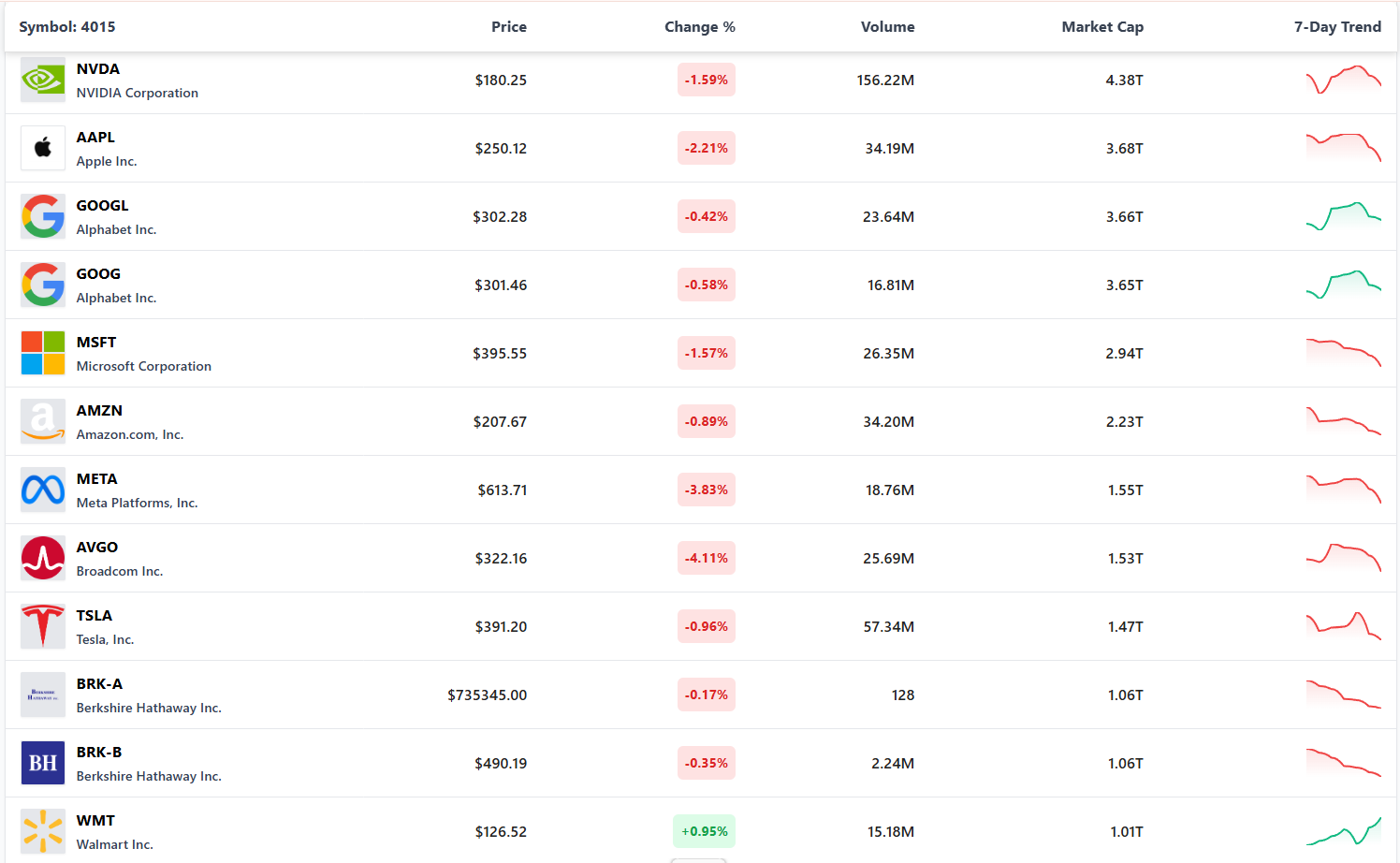
Tickerplace runs multi-model valuation across DCF, P/E, and P/S frameworks for 10,000+ U.S. and ASX-listed companies, updated daily, so you can see whether a stock is overvalued or undervalued before you commit capital. The stock valuation calculator and intrinsic value checker give you the same analytical foundation that institutional analysts use, without a subscription fee for the core tools. For investors who want to go deeper, Tickerplace Pro unlocks full DCF breakdowns, scenario analysis, historical financials, and advanced screeners.
If your goal is disciplined, long-term investing grounded in what a company is actually worth, start with a free valuation check at Tickerplace.
Useful sources
The following primary sources and educational references informed this article and are worth bookmarking for further reading:
- Algorithmic trading
- Algorithmic Trading: An In-Depth Guide to Strategies and Challenges
- Staff of Division of Trading and Markets, U.S. Securities & Exchange Commission, Equity Market Structure Literature Review Part II: High Frequency Trading
- What is Algorithmic Trading? | QuantInsti
- What Is Algorithmic Trading? How Trading Algorithms Execute Orders Using Price, Time, and Volume - Quod Financial
- What is algorithmic trading (OANDA blog)
- Salary: Algorithmic Trader in United States 2025 - Glassdoor
FAQ
How does algorithmic trading work?
An algorithm monitors market data in real time, evaluates it against pre-programmed rules or a statistical model, and submits buy or sell orders automatically when the conditions are met. The system handles signal generation, order sizing, venue routing, and risk controls without human intervention at the moment of execution.
What is a simple example of algorithmic trading?
A basic trend-following algorithm buys a stock when its 20-day moving average crosses above its 50-day moving average, and sells when the reverse occurs. Execution algorithms like VWAP are another common example: they slice a large order into smaller pieces distributed throughout the trading day to minimize price impact.
How much do algorithmic traders make?
Compensation varies widely by role, firm type, and performance. Glassdoor’s salary data provides publicly reported figures for algorithmic trader roles in the United States, though individual outcomes depend heavily on the strategies traded and the capital deployed.
How do I start algorithmic trading as a retail investor?
Begin by defining a clear strategy you understand without code, then learn Python or use a no-code platform to implement it. Choose a broker with a reliable API, backtest against historical data with realistic cost assumptions, forward-test on paper for several weeks, and deploy live only with strict position size and daily loss limits in place.
Is algorithmic trading legal for individual investors in the U.S.?
Yes, algorithmic trading is legal for individual investors in the United States. The SEC, FINRA, and CFTC regulate different aspects of automated trading depending on the asset class. Retail traders must comply with their broker’s policies and avoid prohibited practices such as spoofing or layering, which are illegal under U.S. securities law regardless of whether a human or an algorithm executes them.