
Stock Market News for Long-Term Investors: A Valuation Guide
TL;DR:
- Most stock market news is best viewed as a prompt to update valuation inputs rather than as a trading signal. Significant company events and macroeconomic shifts warrant model adjustments, while sentiment and social media noise generally do not.
Treat most stock market news as a prompt to check your model inputs, not as a trading signal. The single most reliable approach, as Matthew Frankel, CFP at The Motley Fool consistently emphasizes, is buying great businesses at reasonable prices and holding them — not reacting to daily financial market news cycles.
TL;DR: Which headlines deserve immediate attention?
- Act: Earnings reports, guidance revisions, or M&A announcements that materially alter multi-year revenue or margin assumptions.
- Monitor: Macroeconomic policy shifts (Federal Reserve rate decisions, inflation regime changes) that affect your discount rate.
- Ignore: Analyst price-target changes, short-term sentiment swings, and social-media-driven volume spikes.
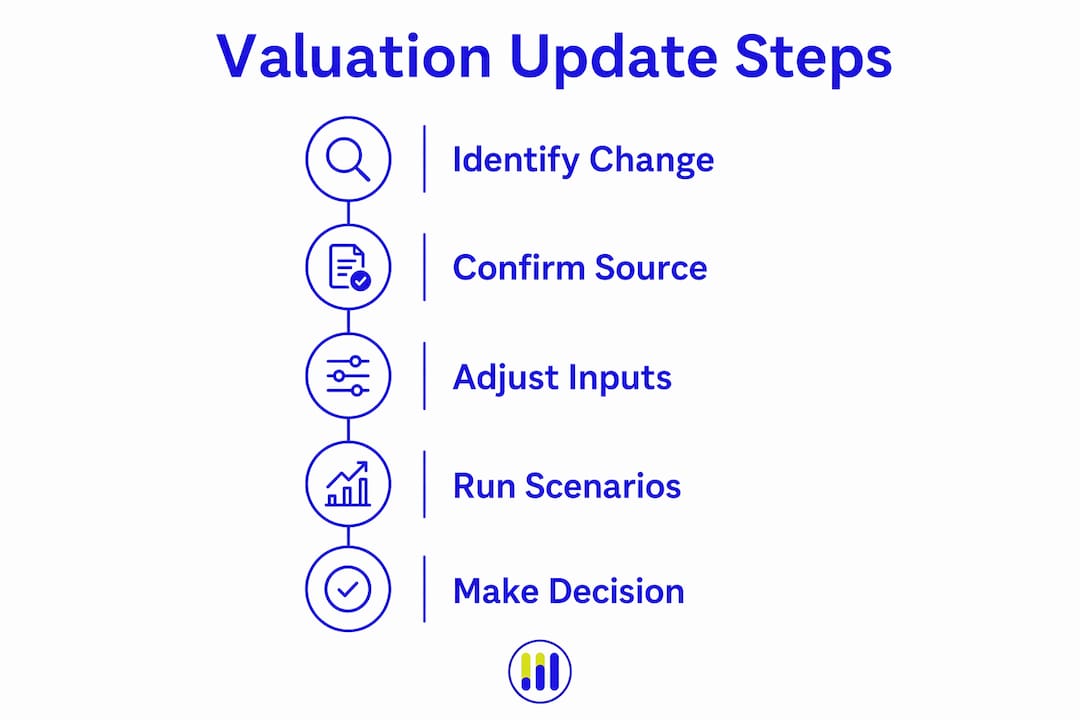
24–72 hour action checklist after a notable headline: Confirm the primary source (SEC filing or company statement) → identify which valuation input changes → run a revised scenario in your model → compare the new intrinsic value estimate to the current market price → decide using your margin-of-safety threshold.
Fidelity’s guidance reinforces this: matching investments to your goals, risk tolerance, and time horizon is the primary driver of long-term success, not responsiveness to the latest stock updates.
Table of Contents
- What kinds of stock market news actually affect intrinsic value?
- How do you separate noise from a real change in fundamentals?
- How to update your valuation models after meaningful news
- How long do news-driven price moves typically last?
- Where should you get reliable market news without overtrading?
- Which tools help you turn news into revised fair-value estimates?
- When should you actually act on a headline?
- Key Takeaways
- How a valuation-first investor actually reads the headlines
- Tickerplace turns market news into valuation decisions
- Useful sources and references
- FAQ
What kinds of stock market news actually affect intrinsic value?
Not all news categories carry equal weight for a valuation model. Understanding the distinction saves time and prevents costly overreaction.

Company-specific fundamental updates (earnings releases, forward guidance, M&A, or management commentary on margins) are the highest-priority category. These directly affect your revenue growth assumptions, operating margin trajectory, and terminal value. An earnings miss paired with a guidance cut, for example, may require you to revise both near-term cash-flow projections and the long-run growth rate embedded in your DCF.
Macroeconomic regime shifts — a sustained change in Federal Reserve policy, a structural inflation reset, or a credit-market dislocation — affect the discount rate (WACC) across your entire portfolio. A 200-basis-point rise in the risk-free rate can compress intrinsic value estimates by 15–25% even when a company’s operating fundamentals are unchanged.
Sector and regulatory changes sit in the middle. A new FDA approval pathway, a tariff on imported components, or a change in data-privacy regulation can permanently alter a sector’s cost structure or addressable market. These require a judgment call: is the change structural (update the model) or transitional (monitor and wait)?
Sentiment and flow events — index rebalancing, short squeezes, options expiration volatility, or social-media-driven price spikes — almost never affect intrinsic value. They move prices, not fundamentals.
The practical rule: Use headlines as pointers to primary sources, never as conclusions. An 8-K filed with the SEC tells you what actually changed; a news headline tells you what a journalist thought was interesting about it.
Pro Tip: Set up SEC EDGAR alerts for your holdings’ 10-Q, 10-K, and 8-K filings. A filing lands before most news articles are written, and the raw numbers are more reliable than any summary.
How do you separate noise from a real change in fundamentals?
The diagnostic is straightforward: run every headline through a five-step filter before touching your model.
- Is the source primary? A company press release or SEC filing is primary. A tweet, analyst note, or news article is secondary — useful as a pointer, not as evidence.
- Does the change affect multi-year cash flows? A one-quarter margin miss driven by supply-chain timing is different from a permanent loss of pricing power.
- Is the change transitory or structural? Transitory events (weather, one-time charges, short-term commodity spikes) revert. Structural changes (competitive displacement, regulatory cost increases, secular demand shifts) do not.
- Is the financial impact quantifiable? If you cannot translate the news into a change in revenue growth, operating margin, capex, or discount rate, it likely does not belong in your model.
- Is the market’s reaction proportionate? A a typical price swing on a single headline is often a sentiment-driven overshoot, not a valuation verdict.
Three quick scenarios:
- Earnings miss: Revenue came in 4% below consensus. Check whether guidance was also cut. If guidance holds, the miss is likely transitory — no model update required. If guidance was cut by 8–12%, update your near-term revenue line.
- Executive departure: A CFO resignation triggers a 10% drop. Run the filter: is there evidence of financial irregularity (check 8-K language carefully) or is this a planned transition? Most planned transitions do not alter cash-flow assumptions.
- Regulatory fine: A one-time fine is a balance-sheet event, not an income-statement trend. Adjust net cash in your model; leave the operating assumptions intact unless the fine signals ongoing compliance risk.
When a price drop is noise, it can be a rebalancing opportunity. When it reflects a confirmed structural change, it is a valuation update. The filter tells you which is which.
How to update your valuation models after meaningful news
Re-run your valuation only when news changes a multi-year input. That single rule prevents most overtrading.
| Model Input | Primary Source | Conservative Example |
|---|---|---|
| Revenue growth rate | Earnings call guidance, 10-K | 9% annually |
| Operating margin | 10-Q segment data | 18% (down from 22%) |
| Capex intensity | 10-K cash flow statement | 8% of revenue |
| WACC / discount rate | Risk-free rate + equity risk premium | 9.5% |
| Terminal growth rate | Industry consensus, macro outlook | — |
Mini worked example: Suppose a company previously guided for a 22% operating margin, and new quarterly results confirm a structural shift to 18% due to rising input costs. In a simple DCF, a 4-percentage-point permanent margin compression on $1 billion in revenue reduces annual free cash flow by roughly $40 million. Discounted at 9.5% over a 10-year horizon, that compression alone can reduce intrinsic value by $250–$300 million. Whether that changes your buy/hold/sell decision depends on the current margin of safety.
For fundamental analysis using DCF, P/E, and P/S models, the key discipline is updating only the inputs that genuinely changed — not reworking every line item for a transitory event. Vanguard’s investor education makes the same point: a robust long-term workflow focuses on a small set of model inputs rather than reacting to every data point.
Pro Tip: Run three scenarios — base, bear, and bull — rather than a single revised estimate. The range tells you how sensitive intrinsic value is to your assumptions, which is more useful than any single number.
How long do news-driven price moves typically last?
Many headline-driven swings are temporary. Prices often revert as the market reassesses fundamentals over the following weeks and quarters, particularly when the underlying business has not changed.
| Metric | Figure | Source |
|---|---|---|
| U.S. adults who own stocks | — | The Motley Fool |
| Historical long-term annual return | ~9–10% | The Motley Fool |
| Typical headline-driven price swing | 15–29% | Business Insider |
Timeline by horizon:
- Days to weeks: Sentiment and momentum dominate. Prices can overshoot in either direction. Avoid making permanent decisions based on this window.
- Quarters: Earnings revisions and analyst estimate resets bring prices closer to revised fundamental expectations. This is when a valuation gap either closes or widens.
- Years: Intrinsic value, not sentiment, determines long-run returns. The ~9–10% historical annual return of the broad U.S. market reflects compounding fundamentals, not news cycles.
A large move that persists beyond two or three earnings cycles warrants closer scrutiny. At that point, the market may be pricing in a structural change your model has not yet captured. Check current stock market trends for context on whether a sector-wide repricing is underway or whether the move is stock-specific.
Where should you get reliable market news without overtrading?
Prioritize primary sources; treat headlines as pointers. That hierarchy protects you from acting on incomplete or mischaracterized information.
Source tiers:
- Primary: SEC EDGAR filings (10-K, 10-Q, 8-K), company investor-relations pages, and official earnings call transcripts. These are the only sources that confirm a fact.
- Institutional: Research notes from established sell-side or independent analysts. Useful for scenario context, but remember that analyst price-target changes often reflect short-term sentiment rather than multi-year earnings power.
- Curated news feeds: Reuters, MarketWatch, and Yahoo Finance surface relevant stories efficiently. Use them to identify events worth investigating, not as the final word.
- Social and aggregator sources: Use sparingly. These amplify sentiment and are prone to manipulation; understanding stock trading scams and rumor-driven price moves is a useful defense.
Monitoring rule: Set alerts only for earnings releases, guidance updates, and material-event filings (8-K) on stocks you actually hold. Broad market news alerts generate noise that erodes decision quality over time.
Fidelity notes that domain expertise gives investors an edge when evaluating sector-specific headlines — if you understand the industry, you can assess whether a regulatory change is material faster than a generalist can. Match your monitoring intensity to your exposure and knowledge.
A practical weekly routine: review filings and earnings transcripts for holdings on a set day each week; scan curated news feeds once daily for material-event alerts; ignore intraday price noise entirely.
Which tools help you turn news into revised fair-value estimates?
The right tools translate a headline into specific model inputs quickly, so you spend time on analysis rather than data gathering.
Core principle: A tool that updates DCF, P/E, and P/S estimates daily across thousands of equities gives you a baseline to compare against your revised assumptions — without rebuilding a spreadsheet from scratch every time news breaks.
Tool types and their roles:
- Intrinsic value / DCF calculators: Translate revised cash-flow assumptions into a fair-value estimate. Essential after guidance cuts or margin revisions.
- P/E and P/S quick-check calculators: Useful for a rapid sanity check when earnings or revenue guidance changes. If the revised P/E at the current price is still above your target multiple, the stock is not yet cheap.
- Margin-of-safety calculators: Quantify the gap between intrinsic value and market price, giving you an objective threshold for action.
- Scenario comparison tools and screeners: Let you filter for stocks where news-driven price drops have opened a valuation gap across the broader market.
Using Tickerplace after a guidance change:
- Open the stock valuation calculator and enter the ticker.
- Review the current DCF, P/E, and P/S outputs against the pre-news baseline.
- Adjust the revenue growth or margin input to reflect the new guidance.
- Compare the revised intrinsic value to the current market price.
- Apply your margin-of-safety threshold to decide whether the gap justifies action.
Tickerplace covers 10,000+ equities with daily multi-model updates (DCF, P/E, P/S), so the baseline is always current. A 200-basis-point increase in WACC, for example, can be tested in the calculator to see how much it compresses fair value before you commit to a position change. The intrinsic value calculator makes that sensitivity test a two-minute exercise rather than a spreadsheet rebuild.
When should you actually act on a headline?
Use objective thresholds, not emotional reactions, to decide whether a headline warrants a trade.
Suggested thresholds (illustrative, not universal rules):
- Adding to a position: Consider adding when the market price falls more than 20–30% below your revised intrinsic value estimate and the fundamental thesis is intact.
- Reducing or exiting: Consider reducing when new information suggests a permanent impairment of 10–15% or more to intrinsic value, not just a temporary price drop.
- Rebalancing: When a news-driven move causes a holding to exceed its target allocation by a meaningful margin, trim to target regardless of the valuation signal.
Tax and transaction considerations matter before you act. Wash-sale rules apply if you sell at a loss and repurchase the same security within 30 days. Tax-loss harvesting is most effective in the final quarter of the calendar year. Transaction costs are small for most retail investors today, but they compound if you trade frequently on headlines.
Pro Tip: Use staged buys or limit orders when adding after a news-driven drop. Prices often continue moving for days after a major headline, and a staged approach reduces the risk of catching a falling stock before the market has fully repriced.
MarketWatch highlights diversification and discipline as recurring themes in long-term investing success. Rebalancing after news-driven moves is one of the few times acting on headlines is genuinely warranted — and even then, the trigger is portfolio allocation, not the headline itself.
Key Takeaways
Long-term investors should treat stock market news as a diagnostic prompt: confirm the primary source, map the change to a specific valuation input, and act only when the revised intrinsic value diverges materially from the current market price.
| Point | Details |
|---|---|
| Headlines are prompts, not signals | Use news to identify which model inputs to check, not as direct buy or sell triggers. |
| Four news categories matter differently | Company fundamentals affect cash flows; macro shifts affect discount rates; sentiment rarely affects either. |
| Swings in stock prices are often temporary | Headline-driven price moves frequently revert as fundamentals are reassessed over subsequent quarters. |
| Act on thresholds, not emotion | Add when price falls 20–30%+ below revised intrinsic value; reduce only on confirmed permanent impairment. |
| Tickerplace for daily recalculations | Use Tickerplace’s DCF, P/E, and P/S calculators across 10,000+ equities to re-run fair-value estimates after material news. |
How a valuation-first investor actually reads the headlines
The most common mistake is treating urgency as a signal. A sharp price move feels like it demands a response, but the feeling is a cognitive trap. The discipline that separates valuation-first investors from news-driven traders is the habit of asking “what changed in the business?” before asking “what should I do about the price?”
The behavioral answer is to build a process that insulates decisions from emotion. Reading the primary filing before reading any news article about it removes the journalist’s framing from your analysis. Running a scenario in your valuation model before checking the after-hours price removes the market’s emotional reaction from your baseline. These are small procedural choices, but they compound over years into meaningfully better decisions.
The core claim of this article is worth restating plainly: most stock market news does not change intrinsic value. The companies that deserve your attention are the ones where a confirmed, primary-source event has materially altered a multi-year assumption. Everything else is an opportunity to practice patience.
Tickerplace turns market news into valuation decisions
Free institutional-grade valuation tools, updated daily across 10,000+ equities, without the institutional price tag.
When a headline moves a stock you own, Tickerplace gives you the fastest path from news to revised fair-value estimate. The stock valuation checker shows whether a price drop has opened a genuine buying opportunity or whether the stock was already overvalued before the news hit. The intrinsic value and DCF calculators let you test revised margin or growth assumptions in minutes. For staged buying decisions after a news-driven drop, the stock average price calculator helps you model the cost basis impact of each tranche.
The core platform is free. Tickerplace Pro unlocks full DCF breakdowns, scenario analysis, historical financials, and advanced screeners for investors who want deeper analytics. Start with the free tools, run your next valuation update, and upgrade when the depth of analysis warrants it.
Useful sources and references
- SEC EDGAR: The authoritative source for 10-K, 10-Q, and 8-K filings. Use it to confirm any headline before updating a valuation model.
- Company investor-relations pages: Official earnings releases, guidance updates, and presentation slides. Always check these before relying on a news summary.
- The Motley Fool: Practical guidance on long-term, valuation-oriented investing; Matthew Frankel’s work is particularly useful for buy-and-hold frameworks.
- Fidelity Learning Center: Structured guidance on matching investment choices to goals, risk tolerance, and time horizon.
- Yahoo Finance: Useful for surfacing earnings events and analyst estimate changes; treat as a pointer to primary sources, not a conclusion.
- Vanguard Investor Education: Clear explanation of valuation-based investing versus news-driven trading; strong on DCF and filing-based analysis.
- MarketWatch: Good for daily market context and behavioral investing reminders around diversification and discipline.
- Tickerplace blog: Step-by-step stock performance evaluation guides that complement the valuation workflow described here.
Re-run valuations only when a primary source confirms a material change. Everything else is background reading.
FAQ
How should long-term investors use stock market news?
Treat daily financial market news as a prompt to check your valuation inputs, not as a trading signal. Act only when a primary source confirms a change that materially alters multi-year cash-flow assumptions or your discount rate.
What types of news actually change a stock’s intrinsic value?
Company-specific events (earnings guidance cuts, M&A, margin revisions) and macroeconomic regime shifts (sustained rate changes) are the categories most likely to require a valuation model update. Sentiment events and analyst price-target changes rarely do.
How big do news-driven price swings typically get?
Headline-driven moves of 15–29% are reported in some cases, but many of these swings are temporary and revert as the market reassesses fundamentals over subsequent quarters.
When is a price drop a buying opportunity versus a warning sign?
A price drop is a potential opportunity when it exceeds 20–30% below your revised intrinsic value estimate and the fundamental thesis remains intact. It is a warning sign when a confirmed primary-source event signals permanent impairment to multi-year cash flows.
Which tools help re-run valuations quickly after a news event?
Tickerplace’s DCF, P/E, and P/S calculators cover 10,000+ equities with daily updates, letting you test revised margin or growth assumptions within minutes of a material announcement.