
Asset Allocation Explained: What Beginners Need to Know

Asset allocation is the way you divide your investment portfolio among major asset classes — stocks, bonds, cash, and alternatives — to manage risk and pursue returns aligned with your goals. According to Investor.gov, this single decision shapes your portfolio’s long-term behavior more than any individual security you pick. A 25-year-old saving for retirement might hold 80% stocks and 20% bonds; a retiree drawing income might flip that to 30% stocks and 60% bonds; a family saving for a house down payment in two years might hold mostly cash equivalents. The allocation decision is personal, and it changes as your life does.
- TL;DR: Choose a target allocation that matches your goals and time horizon, then set a rebalancing rule to maintain it. Tickerplace provides free valuation and calculator tools to help you implement the security-selection phase once your allocation is set.
What is asset allocation, and why does it define your portfolio?
The SEC defines asset allocation as dividing a portfolio among different asset categories such as stocks, bonds, and cash. That division determines how much risk you carry and what kind of returns you can realistically expect. More stocks generally means higher expected returns over time, but also steeper drawdowns when markets fall. More bonds smooths the ride but limits upside.

Think of allocation like climate versus weather. Your strategic allocation is the climate: a long-term setting you choose deliberately. Individual market swings are the weather: temporary and largely unpredictable. Reacting to weather by changing your climate is almost always a mistake.
Practically, a well-chosen allocation does several things at once:
- Aligns your portfolio risk with your actual financial goals and time horizon
- Reduces the emotional pressure to sell during market downturns because you planned for volatility
- Keeps liquidity available for near-term needs without sacrificing long-term growth
- Creates a framework for tax-aware decisions, such as holding bonds in tax-advantaged accounts
Pro Tip: Avoid shifting your allocation in response to short-term market moves. Reactive allocation changes consistently harm long-term outcomes more than they help.
What are the main asset classes and what does each one do?
Every allocation is built from a small set of building blocks, each with a distinct role.
Equities (stocks) represent ownership in companies. They offer the highest long-term return potential among major asset classes, but also the highest short-term volatility. They are the growth engine of most portfolios.
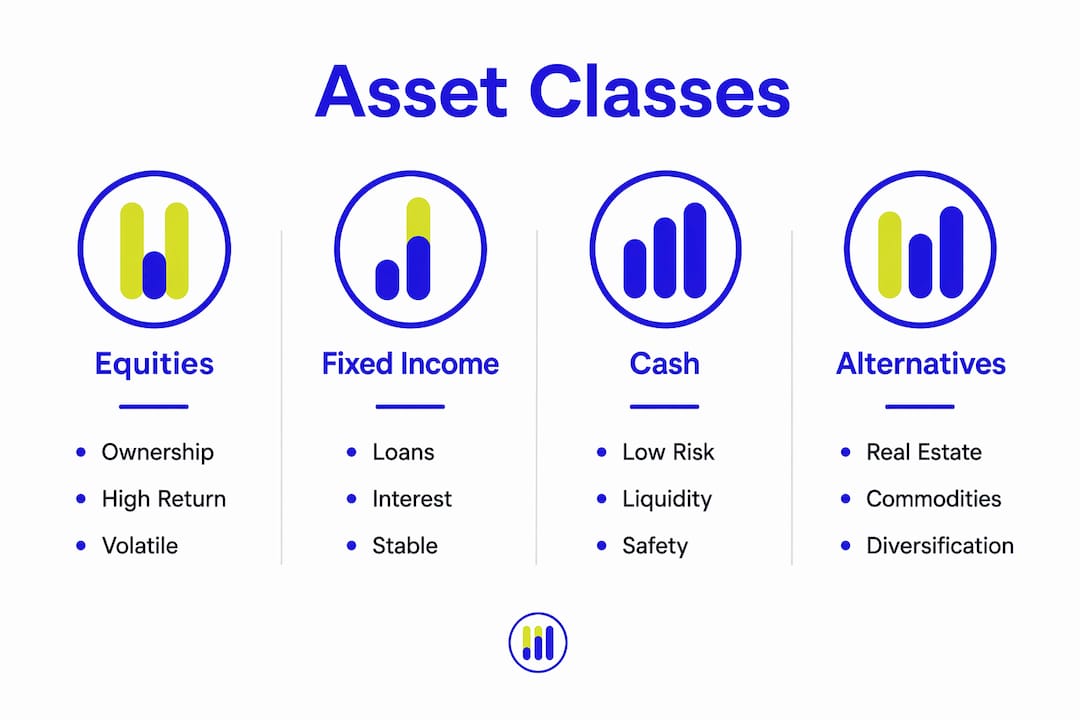
Fixed income (bonds) are loans to governments or corporations that pay interest. They tend to be less volatile than stocks and provide income, making them useful for capital preservation and smoothing portfolio returns. Their returns are generally lower than equities over long periods.
Cash and cash equivalents include money market funds, Treasury bills, and savings accounts. They carry minimal risk and maximum liquidity, but their real returns are often eroded by inflation. They suit short-term goals and emergency reserves.
Alternatives cover a wide range of assets: real estate investment trusts (REITs), commodities, and infrastructure. These can behave differently from stocks and bonds under the same market conditions, which is precisely their value in a diversified portfolio.
The key concept tying these together is correlation. When asset classes do not move in lockstep, combining them reduces portfolio volatility without necessarily reducing expected returns. This is often called the only free lunch in investing. Spreading across classes that respond differently to economic conditions means a loss in one area can be offset by stability or gains in another. Beyond asset classes, diversifying within each class, across sectors, geographies, and issuers, adds another layer of protection. For a deeper look at how these classes compare in practice, this guide to comparing asset classes is a useful reference.
How do you pick an allocation that fits your goals?
There is no single best allocation for every investor. The right mix depends on your time horizon, goals, risk tolerance, and financial situation. Here is a practical decision flow:
- Define your goal and time horizon. A 30-year retirement account can absorb significant short-term volatility. A down payment needed in three years cannot. Separate goals deserve separate allocations.
- Assess your risk tolerance. Ask yourself: if my portfolio dropped 30% in a year, would I stay the course or sell? Honest answers here prevent panic-driven decisions later.
- Apply a starting heuristic. The classic “100 minus your age” rule suggests holding that percentage in stocks (a 35-year-old holds 65% stocks). More modern versions use 110 or 120 minus age to account for longer life expectancies. These are starting points, not prescriptions.
- Account for outside investments. A pension, Social Security, or a spouse’s portfolio all affect your household risk exposure. Factor them in before setting your allocation.
- Consider taxes and fees. Tax-advantaged accounts (401(k), IRA) allow you to hold higher-income assets like bonds more efficiently. Taxable accounts favor tax-efficient equity index funds.
- Test your behavioral tolerance. Review historical drawdowns for your proposed mix. If a 40% drop in a 2008-style scenario would cause you to sell, reduce equity exposure until you find a mix you can hold through a downturn.
- Set a rebalancing rule before you invest. Decide in advance whether you will rebalance on a calendar schedule or when allocations drift beyond a set threshold.
Practitioners consistently recommend setting distinct allocations per goal rather than blending everything into one portfolio. A single allocation across your entire net worth often creates inappropriate risk for at least one of your goals.
What are the main asset-allocation strategies?
| Strategy | How it works | Pros | Cons |
|---|---|---|---|
| Strategic | Set target allocations; rebalance periodically to restore them | Disciplined, low cost, tax-efficient | Ignores short-term opportunities; requires patience |
| Tactical | Adjust allocations based on short-term market views | Can capture opportunities; responsive | Higher costs, taxes, and behavioral risk; hard to execute consistently |
| Target-date funds | One-fund solution that automatically shifts to more conservative mixes as the target date nears | Simple, hands-off, automatic rebalancing | Not personalized; may not reflect your full financial picture |
| Core-satellite | Passive index funds as the core; active or thematic positions as satellites | Balances cost efficiency with flexibility | Requires more active management of satellite positions |
Strategic allocation is the default recommendation for most long-term investors, and for good reason: it is disciplined, low-cost, and avoids the behavioral traps that tactical shifts tend to create. Target-date funds are genuinely useful for hands-off investors, particularly inside a 401(k), but they are built on generic glidepaths that may not match your household’s full picture. Core-satellite suits investors who want the cost efficiency of indexing but also want to express a view on specific sectors or themes.
Why does rebalancing matter, and how often should you do it?
Over time, faster-growing assets take up a larger share of your portfolio than you originally intended. A 60/40 stock-bond mix can drift to 70/30 after a strong equity run, leaving you with more risk than your plan called for. Rebalancing restores the original mix by selling what has grown and buying what has lagged.
| Method | Frequency | Tax cost | Trading cost | Best for |
|---|---|---|---|---|
| Calendar | Annual or semiannual | Moderate | Low | Investors who want simplicity |
| Threshold | When any class drifts ±5% from target | Lower (trades only when needed) | Variable | Investors comfortable monitoring regularly |
A simple example: you start with 60% stocks and 40% bonds. After a strong year, stocks grow to 68% of the portfolio. Under a threshold rule, you sell enough stocks to return to 60% and use the proceeds to buy bonds. You are effectively selling winners to buy laggards, which feels counterintuitive but preserves your intended risk profile.
Tax implications matter here. In taxable accounts, selling appreciated assets triggers capital gains. Strategies to reduce that drag include rebalancing through new contributions, directing dividends to underweight assets, or rebalancing inside tax-advantaged accounts where possible. As Investopedia notes, annual rebalancing is the most common approach under strategic allocation, and it keeps transaction costs manageable for most investors.
- Rebalance in tax-advantaged accounts first to avoid triggering taxable gains
- Use new contributions to top up underweight asset classes before selling anything
- Review allocation after major life events, not just on a calendar schedule
What do conservative, balanced, and aggressive allocations look like?
| Profile | Stocks | Bonds | Cash / Alternatives | Suited for |
|---|---|---|---|---|
| Conservative | 30% | 60% | 10% | Near-term goals, retirees, low risk tolerance |
| Balanced (60/40) | 60% | 30% | 10% | Medium-term goals, moderate risk tolerance |
| Growth | 80% | 15% | 5% | Long-term goals (10+ years), higher risk tolerance |
| Aggressive | 90% | 5% | 5% | Very long time horizons, high risk tolerance |
The 60/40 portfolio is the most widely cited balanced benchmark, and it has served as a reasonable starting point for decades. The conservative mix suits someone within five years of needing the money; the aggressive mix suits a 25-year-old with a 35-year runway who can ride out multiple market cycles.
These are starting points, not prescriptions. Your specific income needs, outside assets, tax situation, and behavioral tolerance all affect where you land. Someone with a generous pension, for instance, effectively already holds a bond-like asset and can afford a more equity-heavy portfolio in their investment accounts.
How does allocation affect retirement withdrawals?
The 4% rule is a widely used retirement-spending guideline: withdraw 4% of your initial portfolio in year one, then adjust that amount for inflation each year. It is a rule of thumb, not a guarantee, and its sustainability depends heavily on your allocation and the sequence of returns you experience.
Sequence-of-returns risk: A retiree who experiences large losses in the first few years of retirement faces a much harder recovery than one who experiences the same average return in a different order. Early losses force you to sell more shares at depressed prices to fund withdrawals, permanently reducing the portfolio’s ability to recover.
This is why retirees often shift toward more conservative or “bucketed” allocations: keeping one to two years of living expenses in cash, a medium-term bond allocation for years two through five, and a growth allocation for the long tail. The cash bucket prevents forced selling during downturns. For taxable accounts, the order in which you draw down accounts (taxable first, then tax-deferred, then Roth) can meaningfully extend portfolio longevity.
What tools help you set and monitor an allocation?
Choosing an allocation is phase one. Implementing it with the right securities and monitoring it over time is phase two. Several tools make both phases more manageable.
An asset allocation calculator helps you model different stock/bond/cash mixes against historical return and volatility data before you commit. A portfolio tracker lets you see your actual allocation in real time and flags drift before it becomes significant. An automated rebalancer handles the mechanics of restoring target weights, which is especially useful in taxable accounts where you want to minimize unnecessary trades.
Once your allocation is set, the next task is filling each bucket with the right securities. That is where valuation tools become relevant. Tickerplace provides free intrinsic value models and a stock valuation calculator that apply DCF, P/E, and P/S analysis to help you evaluate whether a specific stock is priced attractively before you add it to your equity allocation. The platform also offers a stock screener to filter candidates by sector, valuation, and financial metrics, which is useful when building out the equity sleeve of a new allocation. These tools complement, rather than replace, the allocation decision itself. The role of research tools in investing is precisely this: supporting implementation after the strategic framework is in place.
Key Takeaways
Asset allocation is the single most consequential decision in portfolio construction, and getting it right requires matching your mix to your goals, time horizon, and behavioral tolerance before selecting any individual security.
| Point | Details |
|---|---|
| Allocation drives outcomes | Dividing your portfolio among stocks, bonds, and cash shapes long-term risk and return more than individual security picks. |
| Goal-specific buckets | Set separate allocations for retirement, short-term purchases, and other goals rather than one blended mix. |
| Rebalancing is maintenance | Restore your target mix annually or when any class drifts beyond your threshold to preserve your intended risk profile. |
| Taxes and liquidity matter | Rebalance in tax-advantaged accounts first; keep near-term cash needs outside your long-term growth allocation. |
| Tickerplace for implementation | After setting your allocation, use Tickerplace’s free valuation models and screener to evaluate securities for each bucket. |
Why allocation comes before security selection
Most beginner investors spend the majority of their time picking stocks and almost no time thinking about allocation. That is the wrong order of operations. The allocation decision determines roughly how your portfolio will behave through a full market cycle. The security selection decision determines whether you do slightly better or worse than the benchmark within each asset class. Both matter, but they operate at different levels of importance.
At Tickerplace, the educational philosophy reflects this hierarchy. The platform’s valuation tools, including DCF models, P/E analysis, and margin-of-safety calculators, are designed for the implementation phase: once you know you want 60% in equities, those tools help you decide which equities and whether they are priced fairly. Skipping the allocation step and going straight to stock-picking is like choosing paint colors before deciding how many rooms to build. The risk management principles that underpin sound investing all trace back to the same starting point: know your exposure before you optimize it.
Tickerplace gives you the tools to put your allocation to work
Most investors understand the theory of asset allocation but stall when it comes to implementation. Tickerplace closes that gap with free, institutional-grade tools that require no subscription to start. Once your target allocation is set, the platform’s stock valuation calculator applies DCF, P/E, and P/S models to thousands of US-listed equities, giving you a clear view of whether a stock is priced above or below its estimated fair value before you add it to your equity bucket. The stock screener filters by sector, valuation, and financial metrics so you can build out each allocation sleeve with securities that actually meet your criteria.
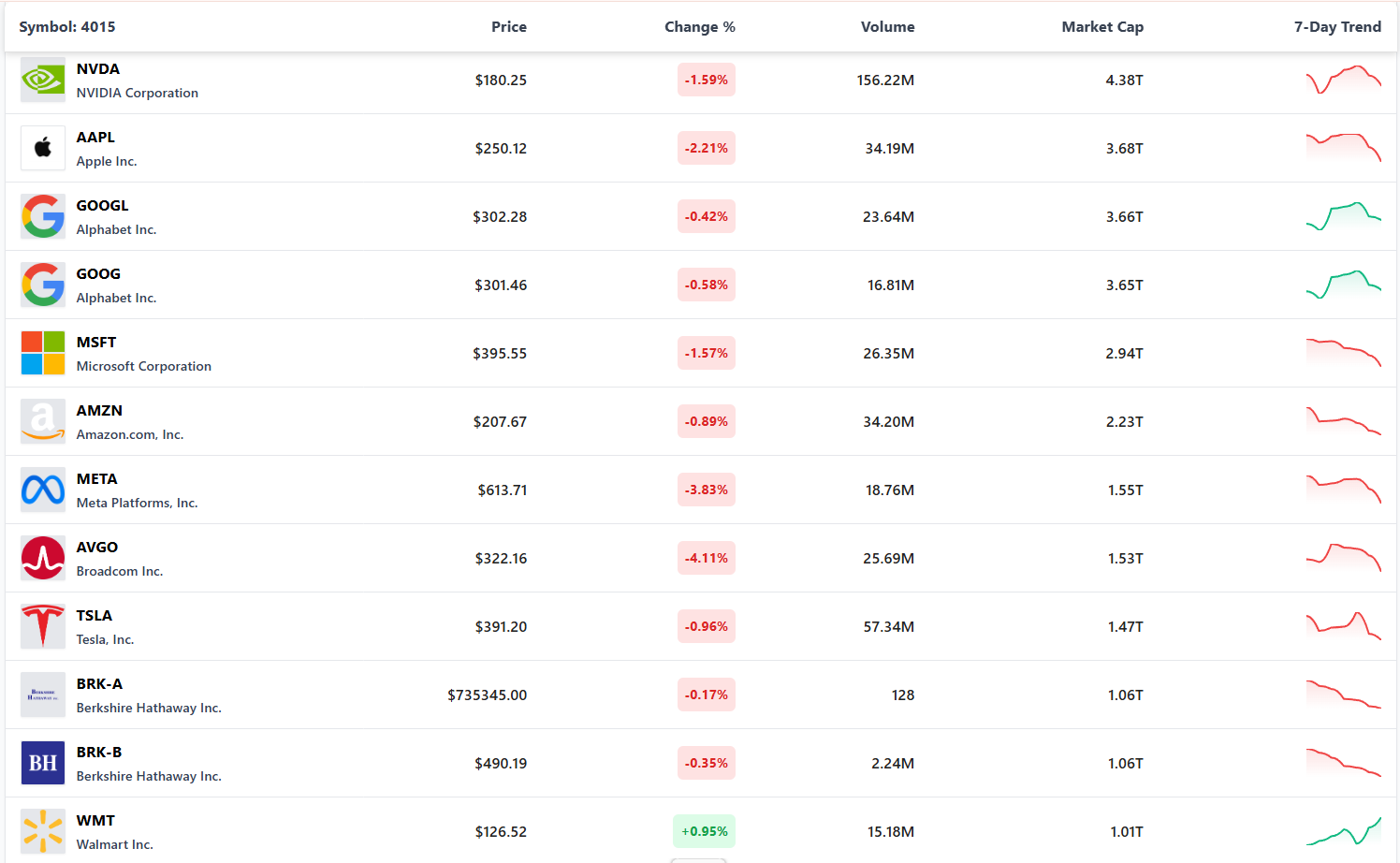
Free core tools cover the full research workflow, with a Pro upgrade available for deeper analytics including full DCF breakdowns, scenario analysis, and historical financials. No long-term commitment is required to access the free tier. Visit Tickerplace and run your first valuation today.
Useful sources and further reading
- SEC Investor.gov: Beginners’ Guide to Asset Allocation, Diversification, and Rebalancing — The U.S. government’s plain-language primer on allocation fundamentals; the most authoritative starting point for U.S. investors.
- SEC.gov: Asset Allocation — The SEC’s own explainer covering how allocation, diversification, and rebalancing work together; includes guidance on risk tolerance and time horizon.
- Vanguard: Model Portfolio Allocation — Vanguard’s model allocation page shows sample mixes and glidepath logic; useful for seeing how a major fund company structures target allocations.
- Investopedia: What Is Asset Allocation? — A thorough reference covering definitions, strategies, and worked examples; good for readers who want more depth on any single concept from this guide.
- Handy.Markets: Asset Diversification Explained — A practical explainer on how diversification across asset classes builds portfolio resilience; a useful companion read on the correlation concept.
FAQ
What is a 70/30 investment strategy?
A 70/30 allocation holds 70% of the portfolio in stocks and 30% in bonds. It sits between a balanced 60/40 mix and a more aggressive 80/20 split, suiting investors with a long time horizon who still want some bond exposure to cushion drawdowns.
What asset allocation is best?
There is no universally best allocation. The right mix depends on your time horizon, goals, and risk tolerance, as Fidelity and other major investment educators consistently note. A 60/40 stock-bond split is a widely used starting point for moderate-risk investors, but your specific situation may call for something more conservative or more aggressive.
What is the 4% rule for asset allocation?
The 4% rule is a retirement-spending guideline suggesting you withdraw 4% of your initial portfolio in year one, then adjust for inflation each year. It is a rule of thumb rather than a guarantee, and its sustainability depends on your allocation and the sequence of returns you experience early in retirement.
How often should you rebalance your portfolio?
Most strategic investors rebalance annually or when any asset class drifts more than 5% from its target weight. Annual rebalancing keeps transaction costs low while preventing significant drift from your intended risk profile.
Can Tickerplace help with asset allocation?
Tickerplace focuses on the implementation phase: once your allocation is set, its free valuation models, stock screener, and calculators help you evaluate individual securities for each asset class bucket. The financial calculators hub is a practical starting point.