
Portfolio Diversification: A Beginner's Guide to Managing Risk
Portfolio diversification is the practice of spreading investments across different asset classes, industries, and geographic regions to reduce exposure to any single security or risk event. According to Investopedia, FINRA, and Vanguard, it remains one of the most consistently recommended strategies in long-term investing. Your most immediate next step: calculate what proportion of your portfolio sits in your top three holdings. If that proportion is large, concentration risk may already be working against you.
Key Takeaways
Portfolio diversification reduces unsystematic risk by spreading investments across assets with low correlation; the two-level approach (asset allocation plus within-class diversification) and periodic rebalancing are what make it work over time.
| Point | Details |
|---|---|
| Definition | Diversification spreads investments across asset classes, sectors, and geographies to reduce exposure to any single risk. |
| How it works | Combining low-correlation assets lowers portfolio standard deviation below the weighted average of individual holdings. |
| Core building blocks | Diversify at two levels: across asset classes (stocks, bonds, cash, alternatives) and within each class (sector, cap, geography, style). |
| Rebalancing is required | Set calendar or threshold-based triggers (e.g., 5% drift) to maintain your target allocation and avoid silent concentration drift. |
| Tickerplace tools | Use Tickerplace’s free intrinsic value calculator, stock valuation checker, and sector analysis tools to audit concentration and check fair value. |
Why does portfolio diversification matter for your returns?
Diversification helps reduce portfolio volatility and lower what investment professionals call unsystematic risk, the risk tied to a specific company or sector rather than the market as a whole. Understanding the distinction between risk types clarifies exactly what diversification can and cannot do for you.
Unsystematic risk is company-specific or industry-specific. A pharmaceutical company’s drug trial failure, a retailer’s supply chain collapse, a single sector’s regulatory shock. Spreading capital across many holdings dilutes this kind of risk substantially. Systematic risk, by contrast, is market-wide: recessions, interest rate cycles, geopolitical shocks. No amount of diversification eliminates it.
The core benefits of portfolio diversification include:
- Volatility smoothing: Losses in one holding are partially offset by stability or gains elsewhere, reducing the amplitude of portfolio swings.
- Capital preservation: A concentrated portfolio can suffer catastrophic drawdowns from a single bad position; a diversified one rarely does.
- Improved risk-adjusted returns: Diversification is about deploying capital efficiently relative to risk taken, not guaranteeing higher raw returns.
- Behavioral benefit: Smoother ride means fewer panic decisions. Investors who watch a diversified portfolio tend to stay invested longer.
One important caveat: Vanguard notes that diversification is a defensive strategy. During strong bull markets, a concentrated position in the winning sector will outperform a diversified portfolio. Diversification caps some upside in exchange for a more consistent long-term trajectory.
How does diversification actually reduce risk?
Combining assets with low or negative correlation is the mechanical reason diversification works. When two assets move independently of each other, a loss in one is not amplified by a simultaneous loss in the other. When they move in opposite directions, losses in one can be partially canceled by gains in the other.
Correlation coefficients) range from +1 (assets move in perfect lockstep) to -1 (assets move in exactly opposite directions). A portfolio of assets all correlated near +1 provides almost no diversification benefit, regardless of how many holdings it contains. The goal is to find assets whose correlations are meaningfully below +1.
A simple illustration: imagine a two-asset portfolio. Held separately, each has meaningful volatility. Combined in equal weights, the blended return is smoother across both environments, because the assets partially offset each other. That smoothing effect is the mathematical core of diversification.
Pro Tip: Diversification reduces idiosyncratic (company-specific) risk, but it cannot eliminate market-wide systematic risk. No portfolio, however well diversified, is immune to a broad market decline. Manage your expectations accordingly, and pair diversification with an appropriate time horizon.
What are the core building blocks of a diversified portfolio?
Effective diversification happens at two levels: asset allocation across major categories (stocks, bonds, cash, and alternatives) and diversification within each category. Investor is explicit on this point: spreading across categories is necessary but not sufficient. You also need to spread within them.
Major asset class roles
| Asset Class | Typical Role | Risk/Return Profile |
|---|---|---|
| U.S. equities | Growth engine | Higher return potential, higher volatility |
| International equities | Geographic diversification, growth | Moderate-to-high volatility, currency exposure |
| Bonds (investment grade) | Stability, income | Lower volatility, lower expected return |
| Cash and equivalents | Liquidity, capital preservation | Minimal return; sensitive to interest rate environment |
| Alternatives (REITs, commodities) | Inflation hedge, low correlation | Variable; depends on sub-asset class |
Within-class diversification tactics
Once you have your asset class mix, apply these within each category:
- U.S. vs. international equities: BlackRock recommends mixing geographies to limit exposure to local market declines.
- Market capitalization: Spread across large-cap, mid-cap, and small-cap stocks. Each segment behaves differently across economic cycles.
- Sector spread: Avoid overweighting any single sector (technology, energy, financials). Sector concentration is one of the most common hidden risks in individual portfolios.
- Style: Balance value and growth stocks. They tend to lead in different market environments.
- Bond types and durations: Mix short-term and long-term bonds, and consider both government and corporate issues. Duration affects sensitivity to interest rate changes.
One trade-off worth naming: adding more holdings and funds increases complexity and can raise management fees and transaction costs; for investors seeking alternatives to standard sources, see this list of institutionalinvestor.com alternatives for additional research platforms. More is not always better. The goal is meaningful exposure to uncorrelated return streams, not the longest possible list of positions. For deeper context on asset allocation fundamentals, Tickerplace’s guide covers the mechanics in detail.
What do common diversified portfolio allocations look like?
Simple allocation templates are starting points, not universal prescriptions. Your time horizon, risk tolerance, and liquidity needs determine which template, if any, fits your situation.
80/20 (Aggressive): 80% equities, 20% bonds. Suited for investors with a long time horizon (15+ years) and the psychological tolerance for significant short-term drawdowns. Expected volatility is high; expected long-term return potential is also higher.
60/40 (Classic): 60% equities, 40% bonds. The most cited benchmark for a balanced portfolio. Historically, this mix has delivered reasonable growth with meaningfully lower volatility than an all-equity portfolio. It has faced pressure in high-inflation, rising-rate environments, which is worth noting for current planning.
40/60 (Conservative): 40% equities, 60% bonds. Appropriate for investors closer to their goal or with lower risk tolerance. Capital preservation takes priority over growth. Expected returns are lower, but so is the probability of a severe drawdown at the wrong time.
Age-based / Target-date heuristic: A common rule of thumb suggests subtracting your age from 110 (or 120 for more aggressive investors) to get your equity percentage. Target-date funds automate this shift, gradually moving from equities toward bonds as the target year approaches. The convenience is real; the trade-off is that the fund’s glide path may not match your specific situation.
These examples are useful reference points. Personalization requires considering your actual income stability, other assets (home equity, pension), and specific financial goals, not just age.
How can you implement diversification efficiently?
Mutual funds, ETFs, and index funds make diversification accessible and cost-efficient for beginners. You do not need to buy dozens of individual stocks to build a diversified portfolio.
Key vehicle characteristics to compare:
- Broad market index funds/ETFs: Low expense ratios (often below 0.10% annually for major index funds), instant diversification across hundreds or thousands of holdings, high tax efficiency, no minimum investment for most ETFs. The most practical starting point for most beginners.
- Actively managed mutual funds: Professional management, but typically higher expense ratios and less tax efficiency than index funds. May have minimum investment requirements.
- Target-date funds: Single-fund diversification that automatically rebalances and shifts allocation over time. Convenient, but the built-in glide path may not match your personal risk profile, and fees vary widely.
- Individual stocks: Maximum control and customization, but require significant research and capital to achieve meaningful diversification on their own. A portfolio of fewer than 20–30 individual stocks in different sectors still carries substantial unsystematic risk.
A practical approach for most beginners: build a core of one or two broad market index ETFs (covering U.S. equities and international equities), add a bond ETF for stability, and use satellite positions for specific tilts (sector, factor, or alternative exposure) if desired. Use Tickerplace’s stock screener to filter holdings by sector, market cap, and valuation when selecting satellite positions.
When and how should you rebalance your portfolio?
Periodic rebalancing preserves your intended allocation and enforces a disciplined buy-low/sell-high process. Without it, strong-performing assets grow to dominate the portfolio, increasing concentration risk over time. FINRA describes rebalancing as the periodic adjustment step that keeps allocations aligned with your goals.
Two common rebalancing approaches:
Calendar-based: Rebalance on a fixed schedule, typically annually or semiannually. Simple to implement and avoids over-trading. The downside is that you may rebalance when drift is minimal, incurring unnecessary costs.
More responsive to actual portfolio changes, but requires more frequent monitoring.
Time horizon shapes the allocation itself. Early in an investment period, you can tolerate more equity exposure and more volatility. As a goal approaches (retirement, a home purchase, a child’s education), shifting toward more stable assets reduces the risk of a poorly timed market decline wiping out progress.
Tax-aware implementation matters. Place tax-inefficient assets (high-yield bonds, REITs, actively managed funds with high turnover) in tax-advantaged accounts like IRAs or 401(k)s. Rebalance within those accounts first to avoid triggering taxable events. In taxable accounts, consider using new contributions to rebalance rather than selling appreciated positions.
Pro Tip: Before rebalancing in a taxable account, check whether the tax cost of selling an appreciated position outweighs the benefit of correcting the drift. Sometimes, directing new contributions toward underweight assets achieves the same result without a taxable event.
What mistakes do beginners commonly make with diversification?
Many so-called diversified portfolios are actually concentrated due to overlapping exposures. Owning five technology-focused ETFs does not create diversification; it creates the illusion of it. Investor.gov warns that buying multiple funds does not automatically create diversification if those funds hold the same underlying securities.
Common mistakes to watch for:
- Overlapping fund holdings: Two S&P 500 index funds and a large-cap growth ETF likely hold the same top 50 stocks. Always inspect fund holdings before adding a new position.
- Chasing recent winners: Vanguard specifically cautions against this. Concentrating in last year’s best-performing sector is a reliable way to buy high.
- Believing 10 stocks equals diversification: Ten stocks in the same sector or with high mutual correlation provide far less protection than the number implies.
- Ignoring correlation: Adding a second asset that moves identically to your first adds no diversification benefit, regardless of how different the names look.
- Over-diversifying: Holding 40 funds with overlapping holdings increases fees and complexity without improving risk-adjusted outcomes.
For a broader view of risk management principles that complement diversification, Tickerplace’s guide covers the full framework.
How do you audit your portfolio for concentration risk?
A short self-audit lets you detect concentration and improve diversification quickly. Work through these steps in order:
- Compute position weights. Divide each holding’s current value by total portfolio value. Any single position above 10% of the portfolio warrants scrutiny. Use a stock average price calculator to confirm your cost basis and current weight accurately.
- Aggregate by sector and industry. Sum the weights of all holdings in each GICS sector. A sector making up a substantial portion of the portfolio is a concentration signal. Tickerplace’s sector and industry analysis tools provide this rollup for individual stocks.
- Check geographic exposure. Identify what percentage of equity exposure is U.S.-only. If international exposure is near zero, you are carrying full home-country bias.
- Assess single-stock risk. For any individual stock position above 5%, review its correlation with your other major holdings. High correlation means less protection than the position count suggests.
- Inspect fund underlying holdings for overlap. Pull the top 10 holdings for every ETF or mutual fund you own. If the same names appear across multiple funds, your effective diversification is lower than it appears.
- Run valuation checks. For individual stock positions, review P/E ratios and intrinsic value estimates to assess whether concentration in a high-valuation stock adds meaningful risk. Tickerplace’s stock valuation calculator runs DCF, P/E, and P/S models to generate fair value estimates.
- Set rebalancing triggers. Document your target weights and the drift threshold (e.g., 5%) that will prompt a review. Calendar a check-in date. Without a written trigger, rebalancing tends not to happen.
How do standard deviation and beta measure diversification impact?
Standard deviation and beta are the two most practical risk metrics for evaluating how well your portfolio is diversified.
Standard deviation measures the dispersion of returns around the average. A portfolio with a high standard deviation experiences wide swings in value; a low standard deviation indicates more consistent returns. When you add a low-correlation asset to a portfolio, the combined standard deviation typically falls below the weighted average of the individual assets’ standard deviations. That gap is the quantifiable benefit of diversification.
Beta measures a portfolio’s sensitivity to broad market movements, typically relative to the S&P 500. A beta of 1.0 means the portfolio moves in line with the market. A beta above 1.0 indicates amplified market exposure; below 1.0 suggests lower sensitivity. A well-diversified portfolio targeting moderate risk will generally have a beta near or slightly below 1.0, with a standard deviation lower than a concentrated equity portfolio.
Together, these metrics help you verify that diversification is actually working. If your 20-stock portfolio has a standard deviation nearly identical to a single-stock position, the holdings are likely highly correlated and the diversification is largely cosmetic. Tracking these figures over time, especially after adding new positions or rebalancing, gives you an objective measure of portfolio construction quality.
How does diversification work alongside other risk management strategies?
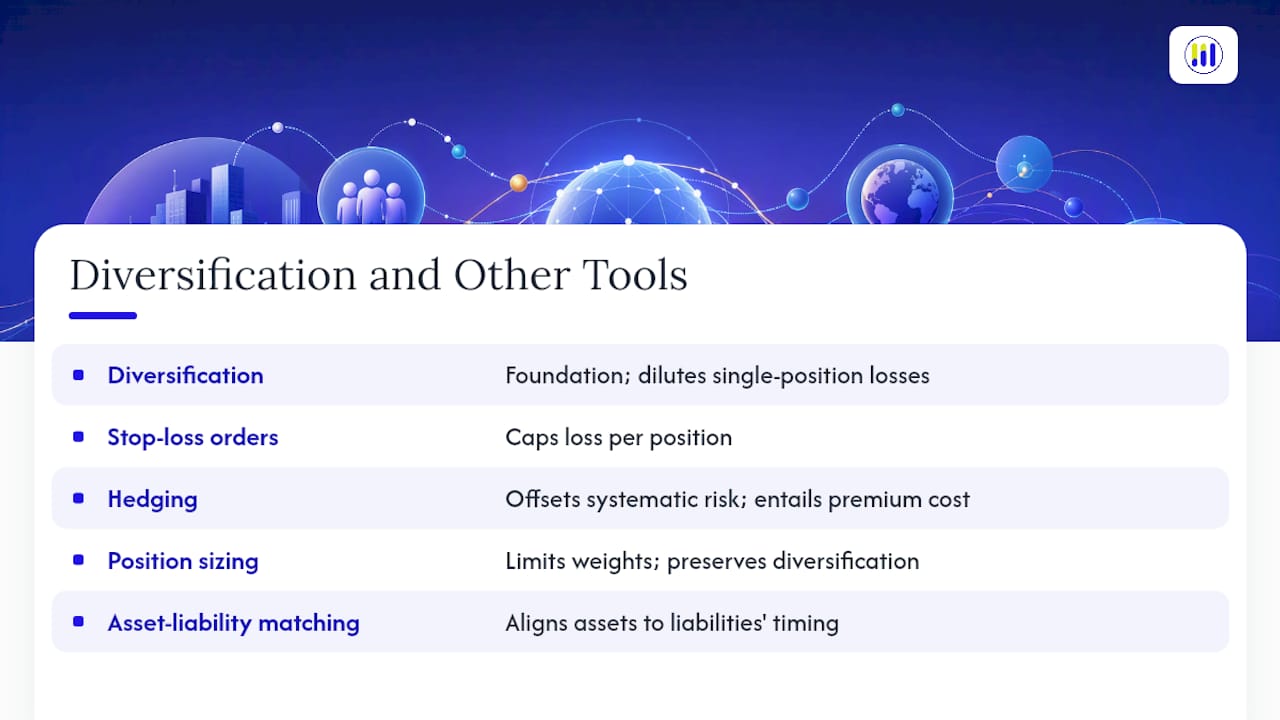
Diversification is the foundation of portfolio risk management, but it works best when paired with complementary strategies rather than used in isolation.
Stop-loss orders set a predetermined exit price for a position, limiting the downside on any single holding. They address the same unsystematic risk that diversification targets, but from a different angle: diversification dilutes the impact of a loss; a stop-loss caps the size of the loss itself. Used together, they create a two-layer defense against single-position blowups.
Hedging uses instruments like options or inverse ETFs to offset potential losses in a portfolio. A put option on a broad market index, for example, can provide protection against systematic risk that diversification alone cannot address. Hedging has a cost (the option premium or the drag from inverse positions), so it is typically used selectively rather than as a permanent portfolio feature.
Position sizing is often overlooked but directly reinforces diversification. Even a well-spread portfolio can be undermined if one position is sized so large that its performance dominates overall returns. Disciplined position sizing, keeping individual stock positions within defined weight limits, preserves the mathematical benefit of diversification.
Asset-liability matching applies particularly to investors with known future obligations (a retirement date, a tuition payment). Matching the duration and risk profile of assets to the timing of liabilities reduces the chance that a market downturn forces a sale at the wrong time. This is the logic behind target-date funds and bond ladders.
Diversification sets the structure; these additional strategies manage specific risks within that structure. For a complete picture of how these tools interact, Tickerplace’s research tools guide explains how to apply them in practice.
Tickerplace’s perspective on diversification as a discipline
Diversification is not a one-time setup. The investors who benefit most from it are those who treat it as an ongoing discipline: setting written allocation targets, reviewing drift on a schedule, and resisting the pull of recent performance. The mechanics are straightforward; the behavioral consistency is where most investors fall short.
Process matters more than perfection. Set rules, automate where possible (target-date funds, automatic rebalancing features in brokerage accounts), and review periodically rather than react to headlines. Tools exist to make this easier. Use them.
Tickerplace gives you the tools to check concentration and value your holdings
Knowing your portfolio is diversified is one thing. Verifying it with data is another. Tickerplace provides free, institutional-grade tools that map directly to the concentration audit described in this article, without requiring a financial advisor or a Bloomberg terminal.
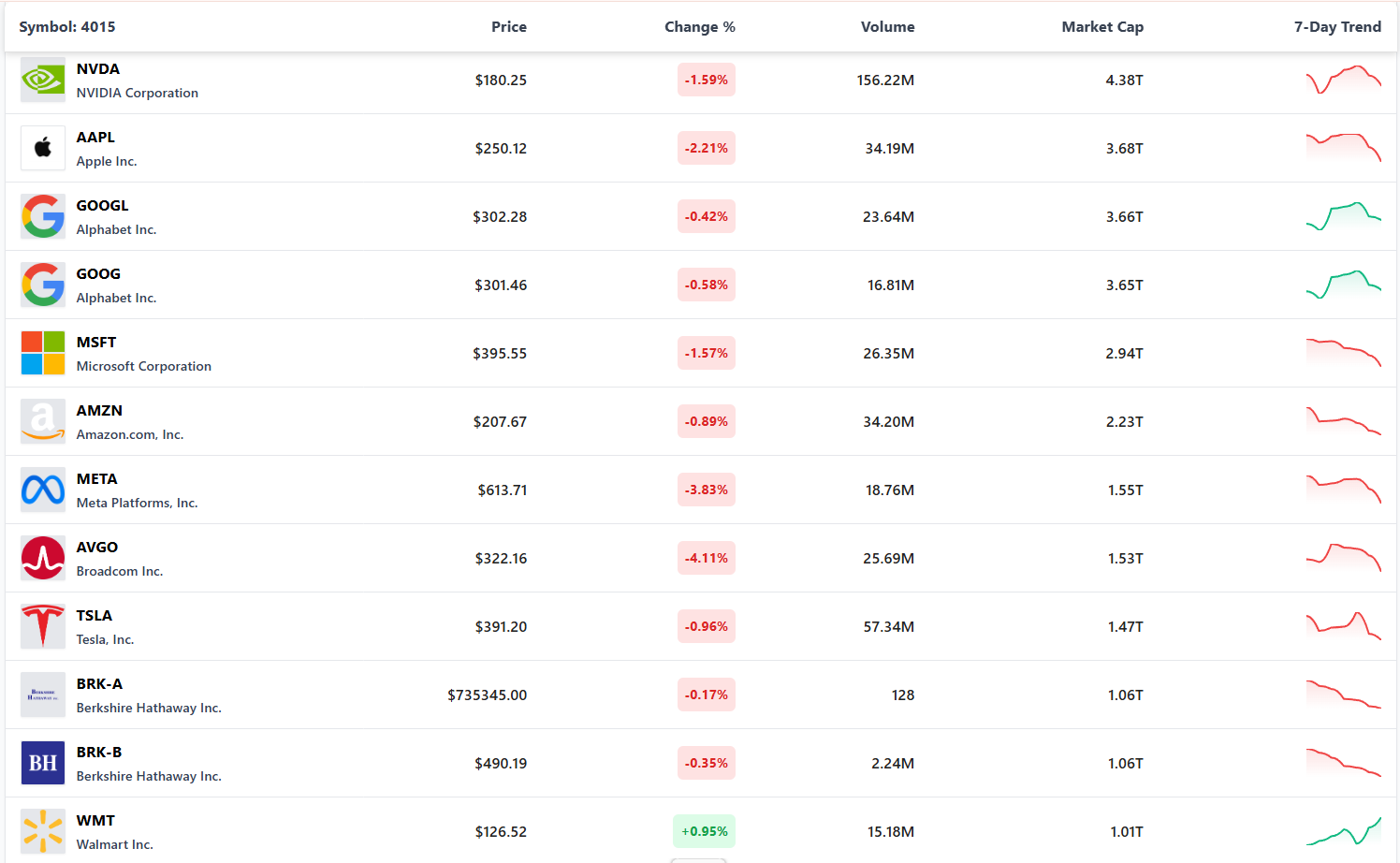
The intrinsic value calculator runs DCF, P/E, and P/S models on thousands of U.S.-listed companies, updated daily, so you can assess whether a concentrated position is at least priced attractively relative to its fair value. The stock valuation checker gives you a quick overvalued/undervalued signal by ticker. Tickerplace’s sector and industry analysis tools let you aggregate holdings by sector to spot concentration before it becomes a problem. The stock screener filters by market cap, sector, and valuation criteria, making it practical to find candidates that genuinely add diversification rather than duplicate existing exposure.
Free access covers the core tools. Tickerplace Pro unlocks full DCF breakdowns, scenario analysis, and historical financials for deeper work. Start with the stock valuation calculator to run your first valuation check on any position you are questioning.
Sources
The following sources informed this article and offer deeper reading on each topic:
FAQ
What is portfolio diversification in simple terms?
Portfolio diversification means spreading your investments across different asset types, sectors, and regions so that a loss in one area does not devastate your entire portfolio. Investopedia defines it as a risk management strategy that mixes a variety of investments to reduce exposure to any single asset or risk event.
What is a good example of portfolio diversification?
Adding an international equity ETF and a REIT for geographic and asset-class spread takes it further, reducing dependence on any single market or sector.
What is the 70/30 rule in stocks?
It sits between the aggressive 80/20 and the classic 60/40, offering growth potential with moderate downside protection; it suits investors with a medium-to-long time horizon and moderate risk tolerance.
Does diversification guarantee against losses?
No. Investopedia notes that diversification aims to reduce unsystematic risk and improve risk-adjusted returns, but it does not guarantee against loss. Systematic market-wide risk affects all asset classes to some degree and cannot be diversified away.
How often should you rebalance a diversified portfolio?
FINRA recommends reviewing your allocation regularly.
This article provides general financial education and is not a substitute for personalized investment advice. Confirm current rules and suitability with a qualified financial professional before making investment decisions.