
Investment Risk Explained: A Beginner's Guide
Investment risk is the degree of uncertainty that your actual investment results will differ from what you expected — including the possibility of losing some or all of the money you put in. Investor defines it precisely this way, and the definition carries a practical implication most beginners overlook: risk is not simply the chance of loss, it is the full range of outcomes on both sides of your expectation. Three things every new investor should internalize before placing a single trade:
- You cannot eliminate risk entirely. Every investment carries some form of it, even a federally insured bank CD.
- Risk and return are linked. Higher potential returns almost always come with higher uncertainty; demanding one without accepting the other is not a strategy.
- Diversification manages risk, but does not remove it. Spreading holdings across assets reduces company-specific exposure, yet broad market forces will still affect a well-diversified portfolio.
Key Takeaways
Investment risk is unavoidable, but it is manageable — the investors who build lasting wealth are those who understand which risks they are taking and why.
| Point | Details |
|---|---|
| Investment risk defined | Risk is the uncertainty that actual results will differ from expectations, including the possibility of losing your principal. |
| Two categories of risk | Systematic risk (market-wide) cannot be diversified away; unsystematic risk (company-specific) can be reduced by holding uncorrelated assets. |
| Core management strategies | Asset allocation, diversification across sectors and geographies, and periodic rebalancing are the most reliable tools for managing risk. |
| Protections have limits | FDIC insures bank deposits; SIPC covers brokerage insolvency — neither protects against market losses or inflation erosion. |
| Tickerplace valuation tools | The free stock valuation calculator and intrinsic value checker help quantify margin of safety and company-specific downside before you invest. |
What are the main types of investment risk?
Understanding investment risk starts with knowing which specific risks can affect your holdings. Each type operates differently, and recognizing them helps you anticipate where a portfolio is most exposed.
- Market (volatility) risk: The value of your investment falls because the overall market declines. A broad index fund drops 20% during a recession even though the underlying companies have not changed fundamentally.
- Business (company) risk: A single company’s stock loses value because of poor management decisions, a failed product launch, or an accounting scandal — factors specific to that firm.
- Credit/default risk: A bond issuer misses an interest payment or fails to repay principal. Municipal and corporate bondholders face this directly; MSRB notes that credit risk affects the issuer’s ability to make promised payments on schedule.
- Interest rate risk: When interest rates rise, existing bond prices fall. A 10-year Treasury you bought at 3% becomes less attractive when new bonds yield 5%, so its market price drops.
- Inflation risk: Your investment’s nominal return fails to keep pace with rising prices, leaving you with less purchasing power than when you started. A CD earning 2% annually loses ground when inflation runs at 4%.
- Liquidity risk: You cannot sell an asset quickly at a fair price. Real estate, private placements, and CDs with early-withdrawal penalties are common examples; Investor flags complex or illiquid products as a primary source of this risk. For a deeper look at how market liquidity works, see Tickerplace’s guide on defining market liquidity.
- Currency (exchange) risk: Investments denominated in a foreign currency lose value in dollar terms when that currency weakens. An American holding European stocks feels this every time the euro slides.
- Political/regulatory risk: A change in tax law, trade policy, or government regulation reduces the value of affected investments. Energy companies, for instance, can be materially affected by shifts in environmental regulation.
- Call/reinvestment risk: A bond is “called” — repaid early by the issuer — when interest rates fall, forcing you to reinvest at lower prevailing rates than you originally planned on.
- Concentration risk: Too large a share of your portfolio sits in one stock, sector, or asset class. If that holding falls sharply, the damage to your overall portfolio is disproportionate.
- Horizon risk: A market downturn arrives just before you need to withdraw funds, forcing you to sell at depressed prices rather than waiting for a recovery.
Systematic vs. unsystematic risk: why the distinction matters
FINRA categorizes investment risk into two broad buckets, and the distinction shapes nearly every practical decision you will make about portfolio construction.
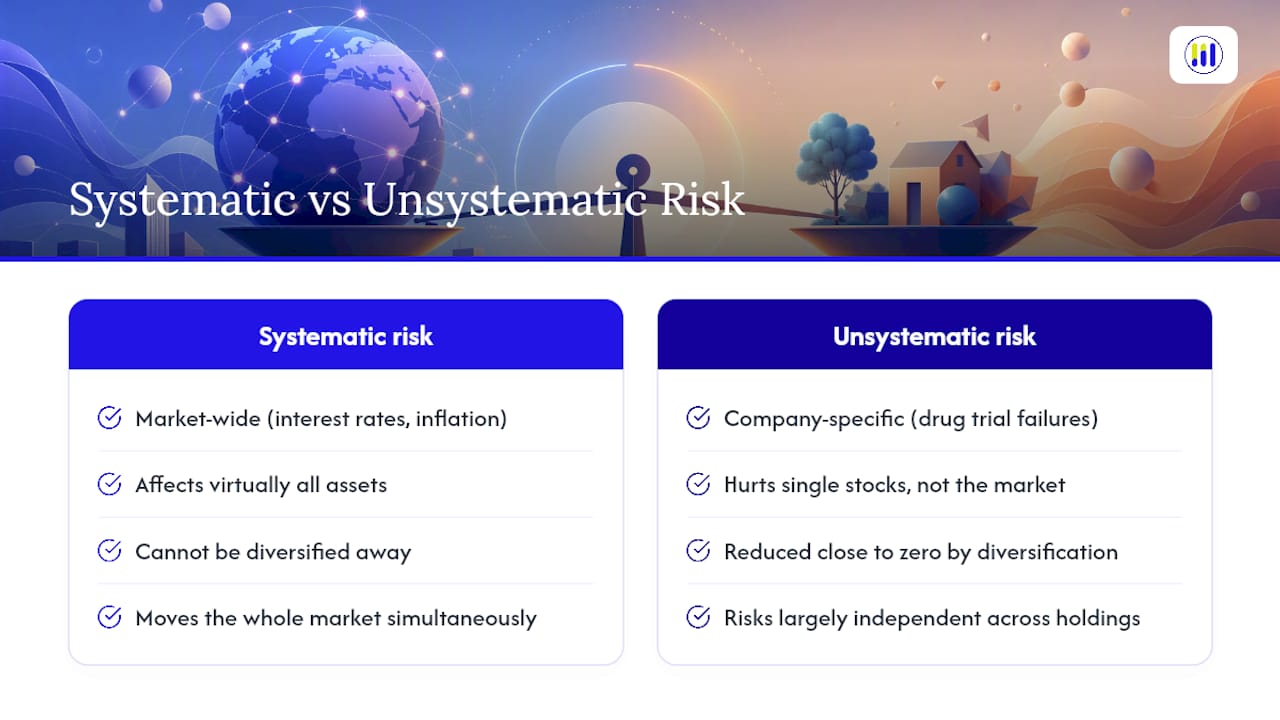
Systematic risk is market-wide. Interest rate changes, inflation, recessions, and geopolitical shocks affect virtually all assets simultaneously. You cannot diversify your way out of systematic risk because it moves the whole market, not just one corner of it.
Unsystematic risk is specific to a single company or industry. A pharmaceutical firm’s drug fails a clinical trial; a retailer’s CEO resigns under pressure; a regional bank faces a regulatory investigation. These events hurt that company’s stock without necessarily affecting the broader market. Because unsystematic risks are largely independent of each other, holding a mix of unrelated companies reduces their combined impact on your portfolio.
Diversification works precisely because it targets unsystematic risk. When one holding suffers a company-specific shock, others in your portfolio are unlikely to suffer the same shock at the same time. The math of correlation means that a sufficiently broad, uncorrelated portfolio can reduce unsystematic risk close to zero — but systematic risk remains.
Pro Tip: Watch for “di-worsification” — the common mistake of adding more holdings that look different on the surface but move together in practice. Owning ten technology ETFs is not diversification; it is concentration with extra steps. Check the underlying holdings and sector weights of each fund before assuming you are spreading risk.
How do investors measure investment risk?
Measurement turns an abstract concept into something you can act on. The metrics below are the ones you will encounter most often, and each answers a slightly different question about your exposure.
- Standard deviation measures how widely an investment’s returns have scattered around its average over time. A stock with a standard deviation of 25% swings far more than one at 10%, meaning you should expect larger gains and larger losses. Investopedia describes standard deviation as one of the most common ways to quantify return dispersion.
- Beta compares a security’s price movements to the broader market, typically the S&P 500. A beta of 1.0 means the stock moves in line with the market; a beta of 1.5 means it tends to move 50% more in either direction; a beta below 1.0 suggests lower sensitivity. A conservative investor building a lower-volatility portfolio will generally prefer holdings with betas below 1.
- Drawdown captures peak-to-trough losses over a specific period. If a fund reached $100,000 and then fell to $70,000 before recovering, its maximum drawdown was 30%. Drawdown is particularly useful for understanding the worst-case scenario you might have to sit through without selling.
- Credit ratings (for bonds) translate an issuer’s default probability into a letter grade. Moody’s, S&P, and Fitch each publish ratings; investment-grade bonds (BBB/Baa and above) carry lower default risk than high-yield or “junk” bonds, which compensate with higher yields.
- Value at Risk (VaR) estimates the maximum loss a portfolio might suffer over a given period at a stated confidence level — for example, a 5% chance of losing more than $10,000 in a month. VaR is standard in institutional risk management; individual investors encounter it mainly in fund disclosures and risk reports.
A practical example: suppose you are evaluating two stocks for a conservative retirement account. Even if Stock B has delivered higher average returns, its risk profile may be incompatible with a short time horizon or a low tolerance for drawdowns. The metrics give you a concrete basis for that judgment rather than a gut feeling.
How can you manage investment risk effectively?
Managing investment risk is not about avoiding it — it is about taking the right risks in the right proportions for your situation. The strategies below each address a different dimension of risk, and most investors benefit from combining several of them. For a deeper treatment of these techniques, Tickerplace’s guide on risk management principles and strategies covers asset allocation and rebalancing in detail.
- Asset allocation: Divide your portfolio across asset classes — equities, fixed income, cash, real assets — in proportions that reflect your goals and time horizon. Stocks offer higher long-term growth potential but higher short-term volatility; bonds provide income and dampen swings; cash preserves capital but loses ground to inflation.
- Rebalancing: Over time, strong performers grow to represent a larger share of your portfolio than intended, increasing concentration risk. Rebalancing — selling some of what has grown and adding to what has lagged — restores your target allocation. A common trigger is a 5% drift from target weights, or a calendar-based review once or twice a year.
- Diversification across sectors and geographies: Owning stocks across technology, healthcare, consumer staples, and energy reduces the impact of any single sector’s downturn. Adding international exposure introduces currency risk but also reduces dependence on the U.S. economic cycle alone.
- Dollar-cost averaging (DCA): Investing a fixed dollar amount at regular intervals means you buy more shares when prices are low and fewer when prices are high. DCA does not guarantee a profit, but it removes the pressure of trying to time the market.
- Bond laddering: For fixed-income investors, spreading bond maturities across multiple years (for example, bonds maturing in 1, 3, 5, and 7 years) reduces interest rate risk and reinvestment risk simultaneously. As each rung matures, you reinvest at prevailing rates rather than locking all your capital into one rate environment.
- Hedging: Options, inverse funds, and similar instruments can offset specific risks, but they add cost and complexity. An investor who buys a put option on a stock they own pays a premium for the right to sell at a set price, limiting downside. For most beginners, the cost of hedging erodes returns enough that broad diversification is a more efficient first line of defense.
Pro Tip: Match your strategy to your time horizon before anything else. A 25-year-old saving for retirement can afford to hold a high-equity allocation and ride out a 30% drawdown. A retiree drawing income from the same portfolio cannot — a prolonged downturn forces selling at the worst moment. The strategy that feels right in a bull market may be entirely wrong for your actual situation.
How does your risk tolerance shape the right investment approach?
Risk tolerance and risk capacity are related but distinct, and confusing them leads to portfolios that either underperform or cause enough anxiety that investors abandon their plan at the worst moment.
Risk tolerance is psychological: how much volatility can you watch without making impulsive decisions?

Risk capacity is financial: how much loss can your actual situation absorb? A 55-year-old with $2 million saved and no debt has higher capacity than a 55-year-old with $200,000 saved and a mortgage, even if both have identical emotional tolerance.
Both dimensions matter. A portfolio calibrated only to capacity may be technically appropriate but emotionally unsustainable. One calibrated only to tolerance may leave long-term wealth on the table.
A short self-assessment covers the key variables:
- Goal: What is this money for — retirement, a home purchase, education, emergency reserves?
- Time horizon: When will you need to access the funds? Short-term needs (under three years) call for lower volatility; long-term goals (ten-plus years) can absorb more short-term swings.
- Emotional tolerance: How did you react during the last significant market decline? Did you hold, add, or sell?
- Liquidity needs: Do you have three to six months of expenses in accessible cash outside this portfolio, or are you relying on these investments for near-term spending?
Pro Tip: Revisit your risk assessment after major life events — a job change, marriage, divorce, inheritance, or a sharp market correction. Your tolerance and capacity both shift with circumstances, and a portfolio built for your situation two years ago may no longer fit.
Are any investments truly guaranteed? What FDIC and SIPC actually cover
A common misconception among new investors is that certain accounts or products protect them from all financial loss. The protections that exist are real and valuable, but their scope is narrower than many people assume.
- FDIC (Federal Deposit Insurance Corporation) insures deposits at member banks — checking accounts, savings accounts, money market deposit accounts, and CDs — up to $250,000 per depositor, per institution, per ownership category. FDIC coverage protects against bank failure, not against the purchasing-power erosion that inflation causes. A CD earning 1.5% while inflation runs at 3.5% is fully insured yet still losing real value.
- SIPC (Securities Investor Protection Corporation) protects customers of FDIC-member brokerage firms if the firm fails and customer assets go missing. SIPC covers up to $500,000 in securities and cash (including up to $250,000 in cash) per customer. Critically, SIPC does not protect against market losses. If your brokerage is solvent and your stocks simply fall in value, SIPC provides no recourse.
- Product-specific guarantees: Some annuities and insured CDs carry issuer guarantees on principal or minimum returns. These guarantees are only as strong as the issuing insurance company or bank; they introduce counterparty risk and often come with surrender charges, caps on upside, or inflation risk that offsets the security they appear to offer.
The practical takeaway: read every product’s disclosure document before investing, and identify specifically which protection — if any — applies to your holding and under what conditions.
Using valuation tools to assess company-specific risk
Systematic risk is largely outside your control, but unsystematic, company-specific risk is where disciplined research pays off. One of the most practical frameworks for stock risk assessment is the concept of intrinsic value and margin of safety.
Intrinsic value is an estimate of what a business is actually worth based on its expected future cash flows, earnings power, and financial position. Margin of safety is the gap between that estimated value and the current market price. Paying significantly below intrinsic value does not eliminate the risk that a company performs poorly, but it does create a financial cushion: if the business delivers results somewhat below your projections, you may still break even or profit because you did not overpay.
Consider a hypothetical: a company’s stock trades at $80. A discounted cash flow (DCF) model, using conservative growth assumptions and a realistic discount rate, estimates intrinsic value at $100. Now suppose the same stock trades at $105 — above estimated fair value. At that price, the investor has no buffer; even a modest earnings miss could push the stock below their entry price. The valuation check does not predict the future, but it quantifies the downside exposure in a way that gut instinct cannot.
Pro Tip: Pay close attention to the inputs driving any valuation model. Aggressive revenue growth assumptions, an unrealistically low discount rate, or ignored debt levels can make an overpriced stock appear cheap. Stress-test the model by running a conservative scenario — lower growth, higher discount rate — and see whether the margin of safety survives.
When evaluating a single-stock position, the key risk indicators to examine include:
- Debt-to-equity ratio: High leverage amplifies both gains and losses and increases default risk in a downturn.
- Free cash flow consistency: Companies that generate reliable free cash flow can service debt and fund operations without relying on external financing.
- Earnings quality: Recurring, cash-backed earnings are more dependable than those driven by one-time items or aggressive accounting.
- Competitive position: A durable competitive advantage reduces the probability that margins will erode under competitive pressure.
A measured perspective on risk from Tickerplace
The most persistent mistake individual investors make is not taking too much risk — it is taking the wrong kind of risk without realizing it. Concentrating in a handful of familiar names, ignoring inflation’s slow erosion of fixed-income returns, or holding cash indefinitely because markets feel uncertain: each of these is a risk posture, just not a deliberate one. Prudent investing means accepting that uncertainty is the price of any return above inflation, then managing that uncertainty through asset allocation, diversification, and periodic rebalancing rather than through avoidance or market timing. A simple valuation check before each purchase — comparing price to estimated intrinsic value — adds one more layer of discipline that most retail investors skip entirely, and it is precisely the kind of systematic habit that separates investors who build wealth over decades from those who simply react to headlines.
Quantify your company-specific risk with Tickerplace’s free valuation tools
Understanding investment risk conceptually is the first step; putting a number on it for a specific stock is where most individual investors stall. Tickerplace’s free stock valuation calculator runs DCF, P/E, and P/S models simultaneously, generating an intrinsic value estimate and a margin-of-safety figure for thousands of U.S.-listed companies — updated daily. If you want a faster sanity check before committing to a position, the stock intrinsic value checker delivers a fair-value estimate by ticker in seconds.
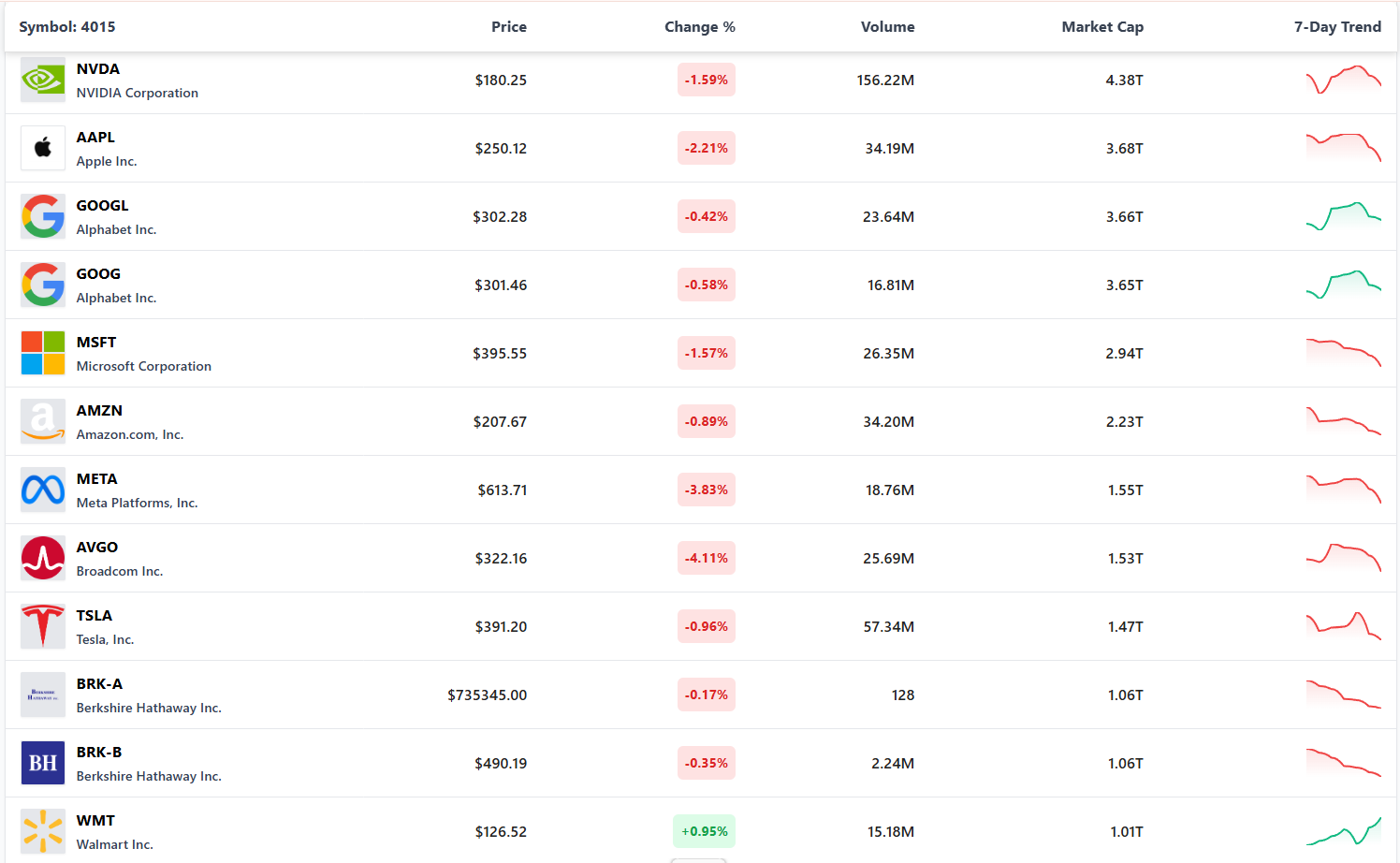
Both tools are free to use. Start with a ticker you are already watching, compare the current price to the estimated intrinsic value, and see whether your intended purchase carries a margin of safety or a premium you need to justify. That single check takes less than two minutes and grounds your risk assessment in numbers rather than sentiment.
Sources
These U.S.-focused resources provide reliable, regulator-backed information for investors who want to go deeper on any topic covered above.
- Investor
- Finra
- Risk: What It Means in Investing and How to Measure and Manage It | Investopedia
- Investment Risks | MSRB
This article is general information, not a substitute for advice from a qualified financial advisor. Consult a qualified financial professional about your own circumstances before acting on anything here.
FAQ
What does investment risk mean?
Investment risk is the possibility that your actual investment returns will differ from what you expected, including the chance of losing part or all of your original capital. Investor.gov defines it as the degree of uncertainty around outcomes and the potential for financial loss.
What best describes investment risk?
Investment risk is most accurately described as the trade-off between uncertainty and potential return: higher expected returns generally require accepting higher uncertainty, while lower-risk investments typically offer more modest gains.
What are the main types of investment risk?
The most commonly cited types include market risk, business risk, credit/default risk, interest rate risk, inflation risk, liquidity risk, currency risk, political risk, reinvestment risk, and concentration risk — each affecting different asset classes and investment structures in distinct ways.
How do you explain investment risk to someone new to investing?
Think of investment risk as the range of possible outcomes around your expected result.
Does diversification eliminate investment risk?
Diversification reduces unsystematic (company-specific) risk significantly, but it cannot eliminate systematic (market-wide) risk. FINRA confirms that broad market forces — recessions, interest rate shifts, inflation — affect all investments to some degree regardless of how well-diversified a portfolio is.